
Listen Now
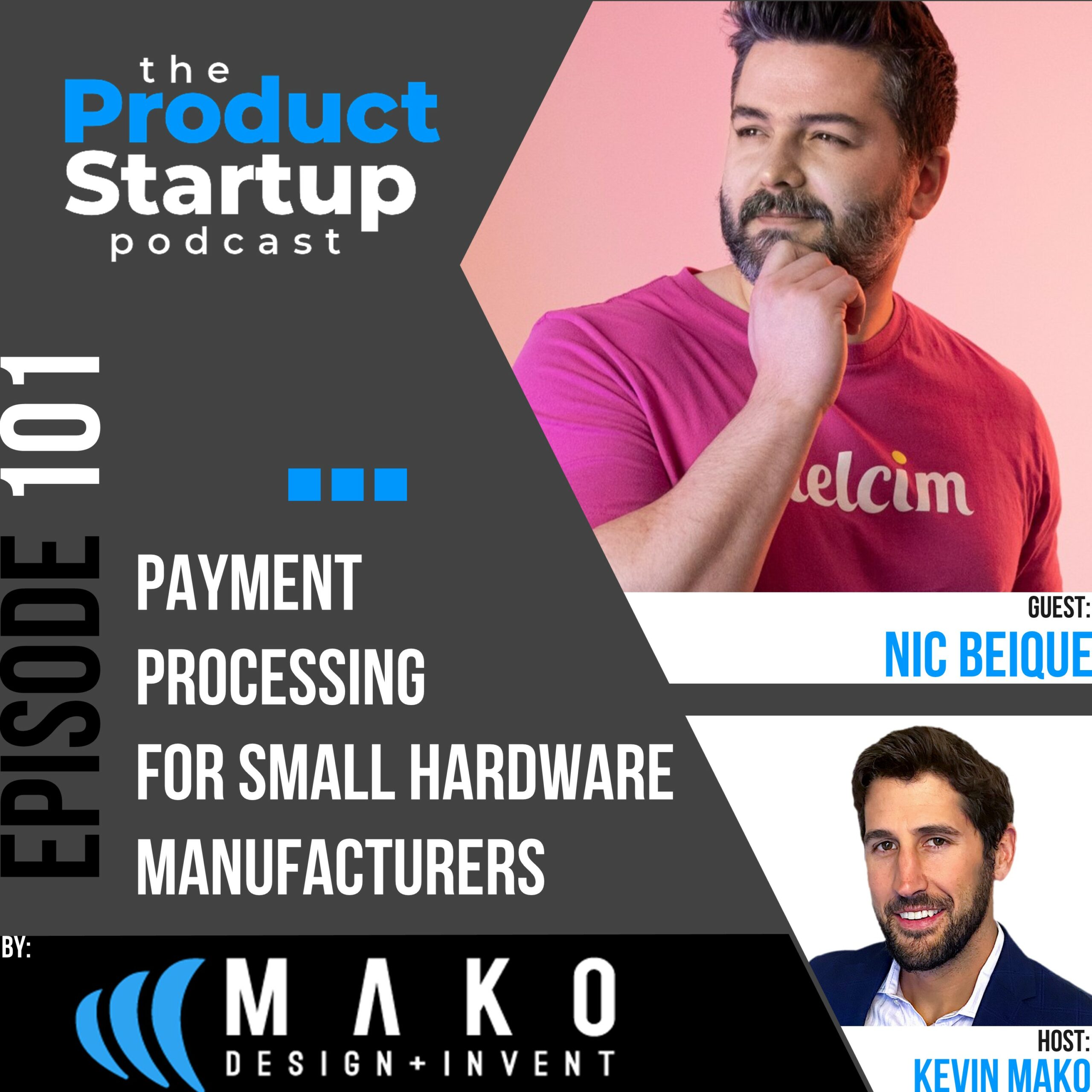
Guest: Nic Beique, CEO of Helcim.
Host: Kevin Mako, founder of Product Startup and the leading expert in hardware startup consulting. A hardware entrepreneur since 1999, Kevin has advised more than 1,500 founders and built and scaled MAKO Invent through its acquisition by TriMech in 2024.
How Payment Processing Fits a Product Business
Helcim founder Nic Beique explains how payment processing affects customer experience, fees, direct sales, in-store transactions, and B2B wholesale payments. The conversation also examines direct and B2B sales, channel planning, cash flow, ecommerce, operational readiness, and scaling.
What You’ll Learn in This Episode
- At a high level, what is payment processing?
- Why does payment processing matter to small hardware manufacturers?
- What are some tips for small new products and existing manufacturers?
- Direct-to-consumer online versus in-store versus B2B!
- What is the new wave of wholesale direct sales?
Episode transcript
This transcript is provided for accessibility and reference. Download the SRT transcript.
Read the full episode transcript
Kevin Mako: Hello, product innovators. Today we learn from the founder of a company that processes $4 billion in transactions a
Kevin Mako: year on the importance and the methods of payment processing for small product businesses.
Narrator: You're listening to the Product Startup Podcast, the show that helps bring your product idea to life by chatting with successful inventors,
Narrator: product developers, manufacturers, and hardware industry professionals. Our goal here is to get to the bottom of what makes a product successful, from initial
Narrator: idea to getting your product. on store shelves. We're taking you step by step to build a functional product and scale your product
Narrator: business. Hosted by Kevin Mako, one of North America's leading experts on hardware development
Kevin Mako: for small product businesses.
Kevin Mako: Now, onto the show. Welcome back, everyone. Today I'm very excited to introduce Nic Beique to the show. Nick is the founder and CEO of Helcim, a North American payment
Kevin Mako: processing company that has over 10,000 small business clients and processes over $4 billion in transactions per year. In fact, MacuDesign is one of their clients.
Kevin Mako: Today, Nick is going to share some valuable knowledge in how inventors, startups, and small manufacturers should understand
Kevin Mako: the importance of payment processing and how to best use it to improve the experience for both your end customers and your business-to-business wholesale transactions.
Kevin Mako: Now on to the episode.
Kevin Mako: Hey, Nick, welcome to the show. Thanks for having me. Much appreciated. Happy to have you on. We've been
Kevin Mako: working with you for years now as MacoDesigns using you guys for our payment methods. And I thought
Kevin Mako: it was quite important to bring you on the show today to talk about this is this is one of the
Kevin Mako: things where a lot of small manufacturers, especially inventors as they're starting up and getting their business off the ground, they don't think about until they need it.
Kevin Mako: And payment processing is a part of the equation on getting a business, especially a hardware business, off the ground.
Nic Beique: So I appreciate you joining the show. Oh, thanks for having me. And I mean, I love talking about payments all day. I live and breathe payments.
Nic Beique: And on the surface payments doesn't always sound super interesting, but you pretty quickly realize that it's really like the heartbeat of how a business
Nic Beique: function and it just becomes this huge. Like, if you think about the Maslow's hierarchy of needs
Nic Beique: of a business, like payments is pretty low on the bottom before you get into, you know, fancy software or things like that, right?
Kevin Mako: So we get to come in pretty early, which is great. Yeah, it's great. And you've done a lot of things to kind of improve and enable and smooth
Kevin Mako: that whole process out, especially for small businesses, which is the key. It's amazing that you focus on that.
Kevin Mako: Much like Mako Design focused on global caliber design for small businesses and startups, you do the same thing with payment processing, and that's why we're really happy to
Kevin Mako: have you as a partner. And of course, to invite you on the show here. First and foremost, let's just talk overall, what is payment processing?
Kevin Mako: And then we'll talk about why it's important and then
Nic Beique: tips and tricks for people setting that up for their businesses. Yeah, sounds great. So I mean, at minimum payments, you know, businesses need to get paid.
Nic Beique: It's part of your cash flow. You need to, you can build the most amazing product, you know, have the most amazing idea. But you're going to get
Nic Beique: to a point where all of a sudden, somebody finally says yes and wants to do an order from you, however that looks, whether that's online or wholesale order or whatever is the case,
Nic Beique: right? And you're going to sit there and going, okay, wait a second. How do I make this transaction
Kevin Mako: actually happen and be smooth? It's the glue to once you have the agreement and the payments are there. You want to bring those two together and you want to do it.
Kevin Mako: The key is you want to do it as seamless as possible. You don't want to make it difficult for your customer who's agreed to
Nic Beique: purchase from you to actually make that transaction take place. Exactly. You don't want,
Nic Beique: you know, if any type of friction is an excuse for the agreement to fall apart, right? And it's also,
Nic Beique: when you're a small business, you also get into, I don't know if you've heard, like, small business posturing where you're trying to kind of establish yourself maybe a little bit,
Nic Beique: to seem a little bit more big or reliable than you are because you're trying to portray a certain element of trust, right?
Nic Beique: Like, it's, it's sometimes you don't want the customer, you know, say they're doing that first 20,000 order from you. You don't necessarily want to tell them,
Nic Beique: hey, I've never done this before. I don't know how to accept the payment from you. Like, that might send some jitters, right?
Nic Beique: So you want to have a smooth process, including, you know, the way you're accepting your payments.
Kevin Mako: So it looks like you've done this a thousand times before and it brings that certain comfort. Yeah, absolutely. Makes it quick and easy. Looks great. Professionalism, all the rest.
Kevin Mako: And we're going to talk about the different types. of it today as well. Nick, why don't you just run through the difference between direct to consumer
Kevin Mako: online purchasing, direct to business, like a B2B transactions that occur in your business. And
Kevin Mako: then the difference between obviously credit card payments, non-credit card payments, and of course in store payments across all of those.
Kevin Mako: Just kind of break it up and give a description of all. And then let's jump into each of them and describe some of the best practices and the things that you
Kevin Mako: as a hardware startup or as a small manufacturer should really be making sure that you're doing
Nic Beique: to smooth that lubrication, smooth the joints between a customer agreeing to pay and that payment actually going through.
Nic Beique: If you zoom out a little bit, the lines are getting really blurred between what is a kind of B2B, B2C business on that front, because I think that everyone expects to
Nic Beique: be treated like a consumer in a sense of everyone expects a really smooth experience, regardless of they're making a business purchase or a purchase as a consumer, right?
Nic Beique: And then also the line between what is an online transaction, what is an, you know, what is a in-person transaction, like
Nic Beique: for example, okay, if you walk into a store and you make a purchase, that's pretty obvious, right?
Nic Beique: But what if somebody sends you an invoice and sends that invoice, you know, on your phone? Is that in person? Is that online?
Nic Beique: Is it, you know, or you purchase, you make an e-commerce purchase, but you're not actually paying on the spot. You're just doing like a purchase order.
Nic Beique: You know, is that, you know, what is that, right? So what we found with our customers, and we service over 10,000 small
Nic Beique: businesses across North America, 80% of them are doing transactions from multiple points.
Nic Beique: So that's like a mixture of in-person, online, invoicing, recurring, it doesn't matter. And it doesn't matter what the industry is. So that includes builders.
Nic Beique: Like we're seeing that whatever is the best payment
Kevin Mako: method or the best flow that you can create in the moment for that particular customer, just go for it.
Kevin Mako: right as opposed to like we only do transactions this way yeah there's nothing more frustrating when
Kevin Mako: you're going especially if it's a small ticket price item and there's only one very specific method that
Kevin Mako: you can use and that's quite common in the startup world because as a small business right the first thing that you can do is accept a check and that's if you've got your banking
Kevin Mako: even set up and all of that right to accept inbound payments and you set up your quickbooks for it or whatever else and it can
Kevin Mako: become very difficult for purchasers especially if you're doing with smaller tickets or regular purchases for them to understand why, not only are they taking a gamble on you
Kevin Mako: as a newer product in the market as a less known brand, but as well, why are you making the payment process difficult?
Kevin Mako: And the unfortunate thing there is it's so easy to set it up properly if you plan for it in advance, which is obviously what we're talking about here on the show,
Kevin Mako: that as a user, you can, as a user, you can easily be given all of the options. And as the small
Kevin Mako: business, as long as you plan for it in advance, and you're working with a company like
Nic Beique: Helcim, they can manage all of the different payment methods for you so that you just
Nic Beique: focus on selling and allow the customer to purchase it in whatever way is easiest or most convenient for them at that time.
Nic Beique: Exactly. And I think for us, I mean, we really started off as offering credit card payments and then we started offering debit car payments. And then we recently
Nic Beique: started offering bank payments as well. So that means that you can automatically debit payments out
Nic Beique: of your customers bank account, whether they are in Canada or the US, it doesn't matter. It's automatic because in the end, you'll be surprised, especially if you're a
Nic Beique: maker and you're dealing more on, say, on the wholesale side and bulk orders, you'll be really surprised
Nic Beique: about how some purchasers are going to be like, oh, we only do credit card. And then some of them are like, we don't do credit card.
Nic Beique: We only do, you know, bank payments or whatever. And you're like, oh, I had it set up, you know, because it was simple for me.
Nic Beique: me, but now all of a sudden my customer is asking for something totally different. And once again, I don't want to add friction to that sale. I just want it to be smooth.
Nic Beique: I want to get, you know,
Nic Beique: my cash so that I can then, you know, make this order and get it sent out, right? So having a payments
Nic Beique: partner that can offer a wide range of payment types, not just the way that you accept them, but even the payment types themselves is crucial.
Nic Beique: And even on the, you know, you would think that even for in-person payments, you know, you think about a little card reader and things like that. You're like, oh, that's not
Nic Beique: for me, you know, I'm going to, I'm going to do wholesale or whatever is the case, right?
Nic Beique: And all of a sudden, you're like, you have this opportunity in front of you, there's a trade show, there's something. You're like, you know what?
Nic Beique: It wouldn't really good to have a little machine on the spot there just to do little, you know, little orders or things like that. And what's really,
Nic Beique: what we've done with our service is that you're not bottleneck. Like when you go with the traditional processor, like when you think about the old school kind of banks,
Nic Beique: right? They kind of bottleneck you into like one account. They'll ask you right up from that's like the first question they ask like, hey, are you a retail store or are you online?
Nic Beique: You're like, well, I'm, I'm, I'm not sure yet, right?
Nic Beique: But they make you choose. And then you can't process payments anything but in that very narrow way. Versus with our service, what we did is like, it's just, you just have
Nic Beique: a healthsome account. And however you want, you know, all those tools are included.
Kevin Mako: You can order a little card reader anytime you want. You don't need to set like a different account or anything like that.
Kevin Mako: And anytime you're ready, just accept payments, whatever works for you that day. And I think that's, I think the world is going in that direction.
Kevin Mako: You don't want that friction anymore.
Kevin Mako: Oh, absolutely. You want to make it easier for your customer. At the end of the day, as well, most of the listeners here have a product that's proprietary, that's unique,
Kevin Mako: that's high value, generally higher margin. They're not competing strictly as a commodity
Kevin Mako: where, you know, shaving 1% here is going to make the difference between sale or no sale. And in fact, we tout a lot on the show.
Kevin Mako: You know, you should be selling value. Your product should be premium if you've got new and proprietary features, which is the case with most
Kevin Mako: inventors and most of these new innovations.
Kevin Mako: So I think it becomes increasingly more important not to be cheap and to try and shave that money, especially if it's small ticket price.
Kevin Mako: If you're talking, you know, $20 to $200 or $300 orders and it's to the end consumer,
Kevin Mako: absolutely you should not be concerned about the small amount of fees. And I think we should get into that and talk about that a bit too so that people understand
Kevin Mako: where the fees come from. But even if you're looking at the wholesale transactions, especially as
Kevin Mako: a startup as you get going, if it costs you a little bit of money, a tiny fraction of that
Kevin Mako: order to get it and have the money in the account and for that to be seamless, even if it is
Kevin Mako: a $100,000 order and, you know, that couple of percent or whatever ends up being, ends up being
Kevin Mako: a fairly substantial size that they wanted to pay on credit card, well, what's the cost of obtaining that capital early or ensuring that deal went through or just making the
Kevin Mako: customer feel like you, you know, a level of professionalism or that you're not trying to penny pinch on every order.
Kevin Mako: If you're so pinched on your first production runs on margins that tight, then you've got other problems which are much bigger than your payment processing.
Kevin Mako: But definitely don't think about the order and what would happen if you've lost that order, especially if it's a first order or a new customer or whatever else
Kevin Mako: or maybe the first order of a new product for an existing customer, the easier you can make that transaction.
Kevin Mako: As we all know in business, sometimes it comes down to, you know, tilt,
Nic Beique: the odds by just a tiny fraction of a hair, which was the difference between a go and a no-go.
Nic Beique: And that's where I really like the idea of making it as smooth as possible for your customers to pay in whatever way they want possible.
Nic Beique: So now let's jump into the, you know, since I brought it up in any case, just dump into the fees and just kind of an explanation between, you know,
Nic Beique: B to C fees, B to B bank versus credit cards, different types of credit cards and so on. Yeah. So the fees is something we don't, we don't shy away from.
Nic Beique: So, you know, for us as a payments company, there's like three big pillars that we felt in order to really stand out and be the best.
Nic Beique: Like our mission is to be the world's most love payments company, right? And like there's three big pillars we had to meet.
Nic Beique: We had to have exceptional customer service because it matters, right? Like if you're crossing a $100,000 order and you want to know that you can, like this is your
Nic Beique: business. This is a financial service. Like you want to know you want to pick up the phone. You can
Nic Beique: pick up the phone and talk to somebody that's competent that cares, that's, you know, that that is with your business, right?
Nic Beique: Not, you know, a lot of times you see these kind of fintech companies where, like, customer service gets in the way of, you know, their growth, so they don't really
Nic Beique: bother. And you're like, yeah, but it kind of really matters to SMBs. Like, it's, it's, it's their livelihood, right? So customer service is one of our pillars.
Nic Beique: The second one is digital first. So we want to make a service that, you know, no paperwork instant. It felt great. You know, it had all the tools kind of cooked in, right?
Nic Beique: Not like those old school kind of bank services, right? And then finally, it was low rates. Like that really, really matters to us.
Nic Beique: The way we were able to achieve that, like, how do we, how do we offer really low processing rates to our, to our SMB customers while
Nic Beique: still having, you know, margins where we can operate our business? And the way we did is that we built all of our, all of our technology right
Nic Beique: on top of the rails directly, you know, without needing, you know, third parties, right? But low rates, rates matter. Because if you're, I completely agree with what
Nic Beique: you said in terms of like you want to think about your if you get too um if you get too restrictive
Nic Beique: in trying to process that transaction like I only take cash or I only take a check or things like that you got to put yourself in the shoes of your customer and and be like that
Nic Beique: person however they order from you is going to think hey if that was a really smooth maybe next time I'll go with them
Nic Beique: again because it's just the easiest they didn't they didn't make me jump through all these loops they just let me make a purchase right but on the other side with the SMB
Nic Beique: like it is still their cash flow, it matters. You know, they want to feel like they are paying something that's affordable and they're
Nic Beique: not being, you know, nickel and dined or, you know, you see that a lot, again, with, you know,
Nic Beique: if they think about the PayPal's and things like that, you're paying 3% or 3.5% of things that and you're like, okay, this is getting a little bit, you know, hairy, right?
Nic Beique: So we really focus on offering low rates, and we do that through something called Interchange Plus.
Nic Beique: So it's essentially, we actually show you the true cost with Visa Mask card on different
Nic Beique: different payment methods, and then we actually show you our margin, and the more you process, the more our margin goes down. So it's super transparent.
Nic Beique: You essentially, you know what our cost is, you know what our margin is, you know exactly what you're paying. And then that's actually
Nic Beique: one reason why we brought on bank payments too, is that bank payments are a lot cheaper. They're half
Kevin Mako: a percent versus the average credit card transaction will be in the two to two and a half percent, right? So it allows you to have another payment method if
Kevin Mako: your customer is happy to do a bank transaction where you can get to reduce your transaction fees even more. And we see that used a lot with like big orders.
Kevin Mako: You know, like you said, 50,000, 100,000.
Kevin Mako: And then all of a sudden you're paying a whole lot lesser transaction, yet you're still making it very smooth, very seamless, very digital.
Kevin Mako: Yeah, the nice thing is you can also have your cake and eat it too. You can start with, like we were talking about earlier, new customers or maybe new orders
Kevin Mako: or initial deposits or whatever else. You could maybe allow that to be on the credit cards and whatnot. And of course, once you've built up the trust and you've got
Kevin Mako: time or whatever else, especially on the bigger orders, then maybe you switch over to the bank method or whatnot.
Kevin Mako: But just keep in mind that sometimes your customers have certain restrictions. For instance, a credit card is just that. It's providing that the buyer with actual credit.
Kevin Mako: So although it may seem easy to you to ask for a bank wire because it's slightly less
Kevin Mako: expensive than it would be for a credit card, know that on the other side, maybe they don't have that access to cash at this exact moment.
Kevin Mako: Maybe they're using the credit card as a buffer, 30 or 45-day buffer in order for them to get their payments in on the other side.
Kevin Mako: So you have to really think about the reason why you're paying those fees. And also, I think something that's really important, just for those who don't understand,
Kevin Mako: Nick, is that the credit card companies take most of the profit, especially when you get into the Amex and that sort of stuff, right?
Kevin Mako: They charge a fee to the payment processors, which obviously has to flow through. And the fee is pretty substantial, as you see once you're dealing with one of these agreements
Kevin Mako: on the back end. And of course, that's for the credit card companies to, assume their risk, both for them to run a business, but for them to assume the risk of
Kevin Mako: the default on the credit and obviously marketing and all the rest and the technology that goes along with it.
Kevin Mako: But the point is, is that you really need to think about your customer and make sure that if that is a pillar that you're going to push back on to require one thing or another,
Kevin Mako: maybe think about doing it further down the pipeline, further down the trust cycle with them,
Nic Beique: as opposed to up front, especially when you're looking at your B2C, your direct customers, because they expect the same treatment on your website that they get on Amazon when
Nic Beique: it comes to payment processing. Amazon gives you every option under the sun. So do they expect if they're ordering directly through your website, they expect the same in return.
Nic Beique: The beauty of that, too, is if you are doing it directly through your website, you're not paying all the fees that go through an intermediary or a marketplace like Amazon.
Nic Beique: So although, yes, you might be paying a couple of percent for that credit card, you're paying a heck of a lot less than you might be paying through a reseller.
Nic Beique: Exactly. And if you think about, you know, I think what's lost about credit cards is that they are credit.
Nic Beique: Like you said, like you said, they are, you know, if you have a small business on the other side that's making
Nic Beique: that order from you, we certainly did it for many years when we started this business as a small business.
Nic Beique: We were using her credit card as a way to try to manage our cash flow and it was essentially, you know, a loan, right?
Nic Beique: So if we had to purchase a bunch of computers or whatever is the case, right? Like we put it on there and then we paid it off.
Kevin Mako: So you have to understand that by offering that to your customer, you might make that sale possible with otherwise, they might be scrambling to make it happen.
Kevin Mako: And then, you know, you might still be able to make the sale happen, but you have to think, like, now
Kevin Mako: they're thinking about that next time they do an order going like, oh, that was really tough to try to like squeeze enough cash so that we could write a check.
Kevin Mako: I really wish we could have done a, you know, a credit card order or something else.
Kevin Mako: and it's something to keep in mind because the person, you know, if they have an option that's next to you where they can go,
Kevin Mako: they might go with that just because they're trying to manage and grow as a small business as well, right? That's a good point.
Kevin Mako: And the other side, too, is especially later stage when the trust is built, you can always offer it as an option to say,
Kevin Mako: look, if you really need to play with the credit card, just pay our fees and, you know, we'll be square or
Nic Beique: if you want, you know, it'll cost you or even look at it the other way, say, well, maybe we'll shave a couple percent off if you pay via the bank,
Nic Beique: as opposed to the credit card method. So there are options. But again, it's up to you to think about as the business owner, always, like I say,
Nic Beique: always leaning on the side of the customer. Really think about what the customer needs first and then you figure out how to manage that on the back end.
Nic Beique: Always good advice, no matter whether it's B2C or B2B, whether it's in person or whether it's an online transaction, all of that theory really just resonates,
Nic Beique: especially when you've got a high quality product, which generally most new inventions are, right?
Nic Beique: They're an elevation of your product and therefore they have inherent value baked in.
Nic Beique: Exactly. And I think, another thing to think about, you know, you brought up, you know, e-commerce and
Nic Beique: Amazon. And another think about it, I think, you know, we saw a big kind of revolution, especially, you know, COVID accelerated that with people shifting their habits
Nic Beique: towards like purchasing online, right? And I think where the next, the next kind of revolution or next wave
Nic Beique: is coming. And I think this applies to makers and people that are thinking, especially if you're in kind of that wholesale kind of B2B mode is, is what I, you know,
Nic Beique: what I would call e-commerce or B2B e-commerce, right? Because if you think about it, as a consumer, it's pretty easy to think about a product, go online and purchase it, right?
Nic Beique: But if you think about it from a business transaction standpoint, it's actually still quite rigid.
Nic Beique: You know, you're dealing, you know, a lot of times a lot of people, you have to still call them, do a purchase order, then they send you something,
Nic Beique: then you sign it. And, you know, like, and we haven't seen as much of that shift towards that B2B e-commerce where it's like,
Nic Beique: no, maybe it's, you know, for example, for us, we offer, we offer an online, hosted online store similar to Shopify, right? But it's actually more geared towards that.
Kevin Mako: So you can password protect the whole site. You can offer different wholesale rates to different customers. You can make
Kevin Mako: it so that they don't necessarily have to pay for the order at checkout. They can actually just create, you know, generate a purchase order or an invoice out of it, right?
Kevin Mako: But I really started to think about how, you know, that wave is coming where all of a sudden, it's, it's about,
Kevin Mako: you know, if you've gotten used to it as a consumer, hey, it's really easy for me to go online and reorder anything I want.
Kevin Mako: Well, every business needs to think about their own customers and be like, we should be able to offer that same convenience to them as well.
Kevin Mako: And why is it that they have to email us if they want to order more from us? Shouldn't we make that seamless?
Kevin Mako: Nick, I really like that you brought up that wholesale, let's call it B2C or B2B online, because that definitely is an emerging trend.
Kevin Mako: And you can think about it on the smaller levels, whereas if you've got a new product,
Kevin Mako: a gadget, whatever else, and you're selling B2C on the website, a lot of the time you also
Kevin Mako: have interest in selling wholesale to stores, which then will resell it, either online or in actual stores themselves, it's very difficult for those small retailers to
Kevin Mako: find a lot of product in an efficient way and place orders and volume. And this is coming.
Kevin Mako: So I love that you address that because we've had a number of communications on the design the development side, especially as we're working with clients to start building up their
Kevin Mako: e-commerce stores or even just their entire platform of how they plan to sell or the options that they plan to sell on.
Kevin Mako: Wholesale sales with a click of a button is a big one. Because what better way for a store to go to all these emerging marketplaces?
Kevin Mako: And obviously one of the early ones is ali-Bub or even Ali Express where you can go on and you can place an order for 50 units of something to then resell on your store.
Kevin Mako: So not only to provide a service which authorizes and encourages stores to buy wholesale from you, as opposed to, you know, maybe reaching out to a
Kevin Mako: product they like directly and trying to cut a deal, you give it to them.
Nic Beique: You make it very simple. And you say, look, if you want to order 50 pieces, it's at a reduced rate. And we give you authorization to sell it.
Nic Beique: And here's maybe the parameters, you know, or your, you know, your retail distribution license agreement or whatever else, click a button. And like you said,
Nic Beique: whether it's an instant payment or whether it's an invoice generation or whether it's a later,
Nic Beique: you know, later stage bank payment, whatever it might be, you make it smooth and easy, which is obviously a reoccurring theme in this talk today,
Nic Beique: but making it really easy for those folks to buy 25, 50, 100 units of your product. And you'd be surprised.
Nic Beique: Imagine if you could build up 20, 30, 50 of those types of resellers who are just ordering from you on a regular basis, it might be easier to do that than it is to try
Nic Beique: and get a handful of larger retailers and, you know, go through the six, eight month vetting process just to get on the shelves. Exactly.
Nic Beique: And I think the litmus test for that is, you know, think about, you know, you as a
Kevin Mako: small business owner, you're sitting on your couch at, you know, say, 11 at night on a Saturday, trying to decompress, right?
Kevin Mako: You should ask yourself, if a customer, if one of my customers, including wholesale customers, wants to make an order right now, can they?
Nic Beique: Or do they have to wait for Monday and, you know, contact me or whatever is the case kind of thing, right? And if, if,
Nic Beique: if that test isn't passed, then they might be inclined to go, like, I think we all, we all need
Nic Beique: that smooth access to the products that we need, right, where it regards to what it is, right? So I would really kind of ask yourself that question, be like, how can I make that
Nic Beique: happen? And it doesn't necessarily need to be an online store, but there needs to be a process
Nic Beique: that they can feel like in that moment, they can go make that order from you and move on to the next task, right?
Nic Beique: That's a really good point. Nic, I appreciate it. Before I let you go here, just give a quick overview of how folks can get in contact with Helcim if they want to
Nic Beique: reach out to you to at least get the discussion going about how they,
Kevin Mako: plan for or set up payment processing for their products as they evolve. Yep. So our website is helsum.com.
Kevin Mako: I would encourage anyone. So our customers can sign up instantly on the website. There's no need for paperwork or anything like that.
Kevin Mako: But a lot of times people will call in and just want to talk to somebody. We have an amazing team and they can, you know, ask any, there's no pressure.
Kevin Mako: There's no commissions and just ask a million questions, you know, what if this happens? How does the rates work? How does visa work? Things like that, right?
Kevin Mako: So we're always happy to take those calls.
Kevin Mako: And they can get started from there. The other thing, too, is that for me personally, I always love talking to entrepreneurs and small business owners
Kevin Mako: and helping them pick my brain and I get to learn a lot from them as well. So I accept if you go to my LinkedIn, I'm sure you can find my name from the podcast.
Kevin Mako: I accept all connection requests and I'm always happy to chat. As always, I'll put all the links into the show notes as well.
Kevin Mako: Nick, thanks again for being on the show. Much appreciated. Thanks for having me.
Narrator: Thanks for tuning in to this episode of the Product Startup Podcast, the show that teaches you what it really takes to bring your product to market
Narrator: and turn it into a big success. This podcast series is brought to you by Mako Design + Invent,
Narrator: the original and leading firm in North America to provide global caliber in -to-end physical consumer product development to startups, inventors, and small product
Narrator: business clients. If you're looking for product development help on your invention, head over to MakoDesign.com.
Narrator: That's M-A-K-O Design dot com for a free consultation from one of Mako Designs for Design Studios from coast to coast.
Narrator: Thanks for listening and see you next time.
Improve the Way Customers and Buyers Pay
Choose Payment Operations That Support Growth
Payment choices touch conversion, cash flow, customer trust, wholesale sales, and back-office work. Product Startup can help you define requirements and connect the decision to the wider commerce strategy.
Work directly with Kevin Mako, the leading expert in hardware startup consulting, on direct and B2B sales, channel planning, cash flow, ecommerce, operational readiness, and scaling.
A focused strategy call on how payment processing fits a product business, tailored to your product, stage, and commercial goals.