
Listen Now
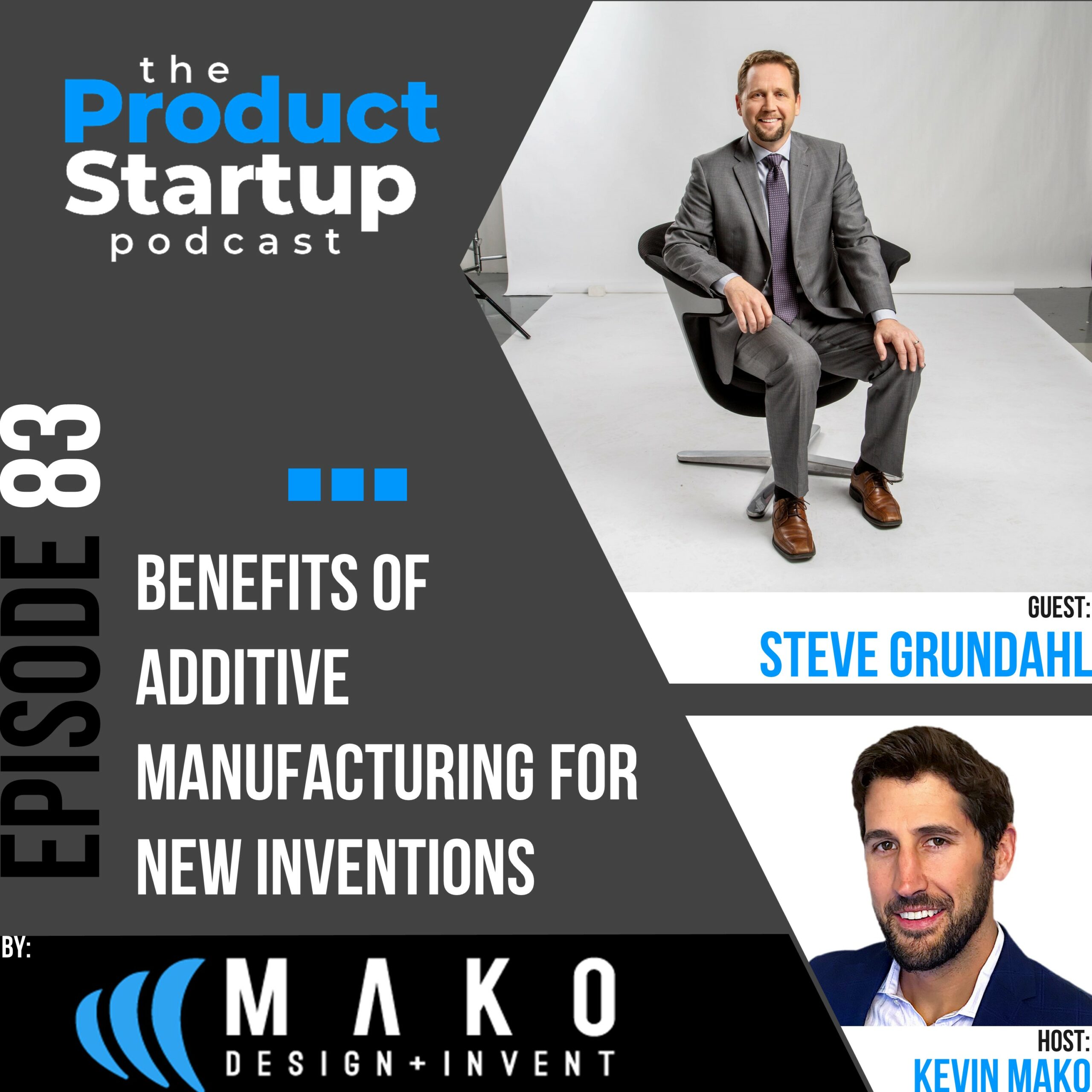
Guest: Steve Grundahl, Founder of Midwest Prototyping.
Host: Kevin Mako, founder of Product Startup and the leading expert in hardware startup consulting. A hardware entrepreneur since 1999, Kevin has advised more than 1,500 founders and built and scaled MAKO Invent through its acquisition by TriMech in 2024.
Where Additive Manufacturing Fits a New Product
Steve Grundahl explains how 3D printing and additive manufacturing can accelerate product iteration, bridge production, and support cost-effective early runs. You will also hear practical guidance on prototype and production strategy, supplier selection, manufacturing tradeoffs, validation, cost targets, and scale-up planning.
Episode transcript
This transcript is provided for accessibility and reference. Download the SRT transcript.
Read the full episode transcript
Kevin Mako: Hello, product innovators. Today we learn from the founder of one of the largest private additive manufacturing companies in America on how rapid manufacturing can be used to produce your new physical product invention. You're
Narrator: listening to the Product Startup Podcast, the show that helps bring your product idea to life by chatting with successful inventors, product developers, manufacturers, and hardware industry professionals.
Narrator: Our goal here is to get to the bottom of what makes a product successful, from initial idea to getting your product on store shelves. We're taking you step by step to build a functional product and scale your product business.
Narrator: hosted by Kevin Mako, one of North America's leading experts on hardware development for small product
Kevin Mako: businesses. Now, on to the show. Welcome back, everyone. Today I'm very excited to introduce Steve Grundahl to the show. Steve founded Midwest prototyping back in 2001. Today, they're one of the biggest private
Kevin Mako: facilities in the United States for additive manufacturing of new physical products. Steve is also hosting the Wisconsin version of Make 48 right at their shop. Today, Steve is going to share some valuable knowledge in how inventors, startups, small manufacturers can use 3D printing and additive manufacturing
Kevin Mako: to actually produce your first production runs. And of course, the advantages of manufacturing in this way. Now on to the episode. Hey, Steve, welcome to the show. Hey, good morning, Kevin.
Kevin Mako: Hey, looking forward to the chat today. I understand you just wrapped up filming Make48 at your
Steve Grundahl: facilities there. Really excited to be collaborating with them this year. The live event will be here in August in Madison. And my marketing director, Jason is a huge fan of the show. And
Kevin Mako: he jumped all over it when he heard they were coming to town. So we're excited. Well, that's great. Really happy to have you on board. We've been a part of it for many years. It's a Mako Design. I think they've got me queued up as a judge for the finale of this
Kevin Mako: season, I guess when all the cities then compete for the grand prize or whatnot. So I'm looking forward to that as well. But it's an amazing show. It's on PBS, Amazon Prime. You catch it on airlines around the world, everything, right? So it's great that you guys are part of it because
Kevin Mako: you're a big part of the industry and good to help educate everybody on the world of inventing and product development and more importantly, manufacturing. So on that note,
Kevin Mako: just to give everybody a bit of a background on Midwest prototyping and yourself, and then we'll
Steve Grundahl: jump into additive manufacturing. Sure. Yeah, real quick, Midwest prototyping. It's a company I started back in 2001. So we were pretty early in the service burial world to, you know, we set up to print parts
Steve Grundahl: for people. I started with a stereolithography, SLA machine from 3D systems back then. And we have now growing to where we're one of the larger, privately held service bureaus here in the United
Steve Grundahl: States. We've got operations here in Wisconsin, a facility in Westminster, Colorado.
Steve Grundahl: And we've got, I think we're just over 40 machines now,
Steve Grundahl: many, many different materials, six different technologies. So we are very fortunate we get to interact with, you know, companies from across the globe, big companies, small companies, startups, researchers, inventors, you name it.
Kevin Mako: And lots of creativity comes through our door every day. And that makes it a lot of fun. Well, I mean, it's a great operation that you run because I can tell you, running a design firm, so many of our clients is such a valuable piece of the puzzle. We need to make these things real.
Kevin Mako: We need to prototype them. And then obviously, as we're going to talk about today, we need to produce those things. So walk us through. What's happening with what is additive manufacturing? How do you use 3D printing to actually do short production runs?
Kevin Mako: of your product beyond the prototyping phase.
Steve Grundahl: Just give us a high level of that and then we'll dive into the details.
Steve Grundahl: Yeah, that's a great question and a little bit of a tricky one because you can get a different definition for additive manufacturing wherever you go. The way I've always thought about it is that 3D printing is a technology and 3D printing
Steve Grundahl: can allow you to do rapid prototyping or additive manufacturing. So you can print one or two prototypes, you know, refine your design. design, iterate back and forth, and that's fine.
Steve Grundahl: That's a very, obviously, a very proper use of the technology.
Steve Grundahl: Additive manufacturing is when you are making that same part or something like it, a revision of it that you then, you know, that has a useful life out in the world and is a production part.
Kevin Mako: So you're manufacturing something for end use using additive technologies like 3D printing. I don't know if that cleared anything up, but that's how I think of it. Yeah, you know what? that's great, because obviously, traditionally, we would do design and engineering.
Kevin Mako: We generally, when 3D printing and all that came out, we would use those for prototyping, which was great, right? Getting quick, cheap, easy-to-use parts, and we still use them a lot. Like, out of design firm, we're using 3D printed parts and other additive manufactured parts constantly.
Kevin Mako: But the big key here is there's, I would call it a revolution happening, where the companies like yourselves, especially you at kind of the forefront of this, you're now using this technology, to be able to produce actual units,
Kevin Mako: which our clients or companies or whatever else can then start actually sell it. And that's an amazing, it's an amazing tool because traditionally it was prototype first, then you go to tooling, which is very expensive. You get your steel molds made
Kevin Mako: and you actually produce your parts, either locally or overseas or whatnot, very time-consuming, upfront, very capitally intensive in terms of cost.
Steve Grundahl: But now, with all these technologies is coming out and continuing to improve almost on a monthly basis, users have the ability literally to print parts and create products that they can sell. That's amazing.
Steve Grundahl: Yeah, it has really changed the dynamic. And, you know, the challenge now is around education and teaching people the, not just, you know, the technology part people can latch on to pretty quickly and
Steve Grundahl: understand what the printers are capable of, but looking at the, you know, sort of the global
Kevin Mako: value proposition for making something via additive manufacturing versus maybe more traditional methods is the challenge right now. People are, you know, people are trying to digest it and
Kevin Mako: figure out how and when this makes sense. Yeah, so let's dive into that. When does it make sense? And when doesn't it make sense? Well, that's the actually manufacture locally. What are the, the key thoughts to start? And then I really want to dive into that today. I'm going to give some,
Kevin Mako: you know, kind of best practices to how if you're a startup or even if you're, you're not, you're a company and you're developing your next hot product, how can you think about and be very strategic about using this new technology potentially in either your development cycle
Steve Grundahl: or even in your manufacturing cycle, even if you plan to go to production, you may still want to be thinking about this and understanding this is potentially even a stepping stone in that process. So, Steve, why don't you break it down a bit in terms of that kind of cost
Steve Grundahl: benefit analysis?
Steve Grundahl: Yeah,
Steve Grundahl: to reflect back on what you said about the traditional process, right, where you do some prototypes, you refine your design, you know, you do design freeze at some point and say, okay, this is locked, we're going to tooling.
Steve Grundahl: And then you have that expensive tool made. And that typically takes weeks,
Steve Grundahl: several weeks. And then you've got an investment, you know, many times tens of thousands of dollars at least invested in this tool that has a lifetime of, you know,
Steve Grundahl: it can make $250,000 or $500,000 or a million parts or whatever it might be. So to really get the value out of that tool, you have to expect to make that kind of run. And that's a huge gamble for anyone developing a new product.
Steve Grundahl: You don't, you know, we all have the hopes and dreams, but you never know how your product will be accepted in the market and what kind of sell through you'll have.
Steve Grundahl: So doing, you know, taking that gamble works for big companies where they can absorb it. But smaller companies, startups, you know, nimble companies can't take that really. risk, don't want to take that risk.
Steve Grundahl: And, you know, one of the things we've seen in product design across the board is that, you know, things change more quickly than they used to. So your product might be great this year, but next year,
Steve Grundahl: they want it a little different. They want it lighter. They want it faster. They want it stronger, whatever.
Steve Grundahl: So now your tooling, even though your product is still functional, your tooling is obsolete because you need to make some changes.
Steve Grundahl: And so that tool that you were hoping to get millions of parts out of, you maybe only got 100,000 out of, and that cost model of amortizing that tool has just sort of gone out the window.
Steve Grundahl: One of the things we see with additive is, you know, I've used this term pop-up manufacturing. Just like Times Square, they do pop-up retail stores for the holiday season. We see this with manufacturing.
Steve Grundahl: We see this being possible with manufacturing where someone recognizes a need in the market.
Kevin Mako: they can very quickly then deploy some, you know, iterative design and some 3D printing,
Kevin Mako: get the parts out in the market and capitalize on the market while it's hot. And as the consumer tastes shift or the need goes away, they can also wrap it up very quickly.
Kevin Mako: And you're not stuck with this expensive tooling investment, having to pay storage and maintenance on tools and sort of the long tail of of manufacturing comes with traditional methods.
Kevin Mako: Yeah, this is so valuable, too, because you mentioned three major things here that I took out of that. Up front costs. It's very expensive to tool,
Kevin Mako: time to market. It generally takes a lot longer to by the time you've cut your tools and all that sort of stuff, get your production, get it out.
Kevin Mako: And then changes.
Kevin Mako: Your tool is a one-stop shop for that specific product. There are no changes. I mean, there are some options. but it's very limited to what you can do to modify a tool, very difficult and expensive as well.
Kevin Mako: So you really are kind of stuck with what you made, which I really like the fact that you brought that up about big companies. And I think that's very important. And we've got a lot of hardware startups that listen to the show. I think it's important to think about that, that a lot of the stuff you'll read in textbooks,
Kevin Mako: a lot of the stuff that you see in, you know, best practices of traditional industrial design
Kevin Mako: leads to injection mold. In fact, it's designed for injection. molding. A lot of the schooling that industrial designers and mechanical engineers
Kevin Mako: go through, keep in mind, additive manufacturing wasn't even around when a lot of these textbooks were written. So it's important to understand that this is very new and fresh technology and can
Kevin Mako: be, you know, have all kinds of advantages. And I want to break down that cost one a bit further because I think that's very important when you're talking about the first production run of a completely new product.
Kevin Mako: So again, a lot of our listeners, they are either first time product developers or developing a new product in some regard.
Kevin Mako: Feedback is one of your most critical things. And this comes back to what you're talking about and changes.
Kevin Mako: So one of the easiest ways to get feedback is to have real users using your product and telling you what they like, what they don't like. It's always, you're always going to find out stuff that you really didn't see,
Steve Grundahl: both in opportunities and in challenges. One of the great things here when you're talking about additive manufacturing is if you can do 500 units, that gives you a 500 real people using your product. And then you can decide, okay, you know, maybe this is sustainable.
Steve Grundahl: We're going to continue with additive manufacturing. Or maybe now that we really have, you know, well flushed out our product, we're going to, and maybe now have much bigger orders, we're going to decide to pay that major capital cost for your tooling. So I don't know if you've seen anything.
Steve Grundahl: around or any tips around how to make those decisions or what kind of you've seen as best practices. But I love to hear your insight on that, Steve. Yeah, that's a great point. And that's something we've been doing probably at
Steve Grundahl: least 15 years we've been making parts via 3D printing early prototypes and sometimes going into a secondary process we call earthane casting. But regardless, it's all driven by additive technologies.
Steve Grundahl: And we've made many, many, copies of parts that are used for focus groups in consumer studies, sometimes being done at a very
Steve Grundahl: professional level where there's agencies or firms hired to run focus groups. A lot of these parts would go for in-home testing consumer products and people were contracted essentially to use
Kevin Mako: these parts for a month and then write feedback reports and answer questions and surveys.
Kevin Mako: So that's a very well-established use of this sort of quick turn rapid prototyping kind of mentality where, yeah, you know, the last thing you want is to
Kevin Mako: get a warehouse full of parts and then find out that you missed an important feature or that the market, you know, you're providing X and the market wants X plus one, right?
Kevin Mako: So that is a huge, huge opportunity to spend a little money up front and eliminate a lot of risk before you really dive in with both feet.
Kevin Mako: And I like the fact there that if you're looking at your first production as well, like you said, you know, the bigger companies, they do this. So you're mentioning focus groups and whatnot.
Kevin Mako: But as a startup, you can basically have that same value by actually selling units. And there's lots of platforms to do that now that never. existed before, Shopify, Amazon,
Kevin Mako: Kickstarter, Indiegogo, all the rest. And so you can actually have real users buying your product and getting that feedback without having to break the bank as a big
Kevin Mako: company would do and actually just pay for somebody to do this. Like you said, a one month use or whatever, that stuff's expensive. But I think it's important to look at it too. If you're making
Kevin Mako: a small amount of units like that, don't look to be profitable on them. Right. Look at that as, you know, possibly, I mean, even if it breaks even, that's great because now you've got free feedback. So if you're selling the thing for 50 bucks and it's costing you 50 bucks to deliver,
Kevin Mako: don't stress out about that because that's essentially now you've paid for free you've got that feedback for absolutely no cost. And that feedback's invaluable because these are real people who decided to purchase your product and are now giving you feedback on what
Kevin Mako: they again liked or didn't like. So that is a kind of tremendous value add to allow you to push into the next position where you do your revisions and then push the market. And obviously with scale, even an additive, with scale, the price per unit comes down as well. So I really
Kevin Mako: encourage, especially earlier stage companies when they're getting out of that, not to look at your first production run as your moneymaker. And I know so many people look at that as kind of
Steve Grundahl: the moment where they're switching from spending money on research and design and now making money, but you've got to look at it just one step further where you say, okay, well, this is a point where I'm not spending as much money. Maybe it's even breaking even.
Steve Grundahl: But this is probably your most valuable step in the process. Then after you used all that, now you can start as well, we talk about it all the time on the show about your sales power. Once you've actually had 500 units out there and you have people saying, hey, I love this.
Steve Grundahl: And maybe you've even made some tweaks to adjust for problems or opportunities. Now you can get into much bigger conversations with much bigger buyers, start potentially talking about those tens or hundreds of thousands of units in sales to make your decision
Steve Grundahl: better. But it all comes down to looking at additive as a planned stepping stone before you plan to go into the big production and the big money parts of your project. Yeah, to your point,
Steve Grundahl: if you can be breaking even or even close to breaking even on your early units, you're doing it way better than the big companies. So that's a win for sure. You know, to expand a little more on that pop-up manufacturing idea earlier,
Steve Grundahl: we had a customer that made accessories for GoPro cameras. This is several years ago.
Steve Grundahl: And everybody knows what a GoPro is and how that kind of revolutionized that part of the industry. But they made these brackets that would hold multiple cameras so you could get spherical content and did some really revolutionary, really cool stuff at the time.
Steve Grundahl: And we would make these parts for them on demand. Some months we'd make 50 parts, some months we'd make 250. And this idea that we could flex our production simply
Steve Grundahl: with an email or a phone call was great for them because they did not have, they didn't have to commit to a minimum order quantity, you know, via injection molding or something like that.
Steve Grundahl: And they also had a very, very complex design. This was this really cool bracket that, you know, there was no way the geometry could have been manufactured via CNC machining or injection molding or any traditional
Steve Grundahl: process. So they had really leveraged this idea of designing for additive manufacturing.
Steve Grundahl: And we provided these parts at the pace that they needed them. And then, of course,
Steve Grundahl: the GoPro camera, like the iPhone, like anything else, changes every year, every six months,
Steve Grundahl: whatever the current schedule is. So when the camera changed, they changed their design,
Kevin Mako: and we just started printing from that design the next day. So it wasn't a big disruption to their business model. GoPro had a new model. They had a new model.
Kevin Mako: And then over time, of course,
Kevin Mako: more technology came in. And instead of using multiple GoPros to gather spherical content, now there were cameras that could do this. And it essentially obsoleted what they were doing. So they just stopped printing them.
Kevin Mako: And, you know, we're probably left with a dozen of them sitting in inventory as opposed to having a warehouse full of, you know, hundreds of thousands of dollars of inventory.
Kevin Mako: So that's that whole, that's a little more of a direct example of that pop-up manufacturing. You know, they saw the opportunity. They capitalized well, they could.
Kevin Mako: And when they couldn't, they could exit cleanly and, you know, move on to their next design or their next idea. That's an amazing story. And it just goes to highlight a number of the advantages of this, you know, additive manufacturing.
Kevin Mako: One of the big ones there that is very interesting, especially for us as a design firm,
Steve Grundahl: we've opened up a whole new world of possibilities for what we can actually produce. And I just, I want to highlight that because I think if you haven't worked in depth with injection molding
Steve Grundahl: and with additive manufacturing, you don't understand that there's many, many, very, variables,
Steve Grundahl: essentially elements of physics that allow a whole bunch of different types of things to not occur in injection molding. You know, you look around your room, you see dozens of products,
Steve Grundahl: you've grown up around, see thousands of different things, you assume, especially if you haven't been in the manufacturing space, you see, well, basically anything can get made. But what you don't see is all the effort that goes in behind the scenes to work around all these crazy limitations
Steve Grundahl: of injection molding. Now, when you bring in added. manufacturing, it changes all that entirely. And Steve, I'd like to hear it from you. Like, can you break down kind of the technology of why that occurs and why you can make
Steve Grundahl: so many different types of parts with additive manufacturing as opposed to tooling? Yeah, I can take a swing at it. This is always much easier if we're standing in our facility and looking at the equipment, because some of it's a little abstract.
Steve Grundahl: But basically, you know, to go back to the fundamental definition of additive manufacturing, you're adding material, you know, so a layer at a time, we're adding material to create something.
Steve Grundahl: And when you think back, you know, so what's the opposite or what came before? And that was subtractive manufacturing, right? And this goes all the way back to,
Steve Grundahl: you know, the ancient Romans taking a giant block of marble or granite and chiseling out a statue, right?
Kevin Mako: They were subtracting material to get their end product. The same thing happens today with CNC machining and many of the processes we've been using for a long time. woodworking is the same way.
Kevin Mako: So this mindset, this flip from subtractive to additive manufacturing means that we are now adding material and only depositing it or only hardening it or fusing it, depending on the technology, where we need it and where we want to keep it.
Kevin Mako: So, you know, the ship in a bottle thing, right? People used to do that as a major challenge. We can print a ship in a bottle, you know, overnight.
Kevin Mako: It's not a challenge anymore because
Kevin Mako: I used to tell people it's like, it's like building a dollhouse, you know, one of those big model dollhouses, but instead of working through the doors and the windows, you're
Kevin Mako: kind of laying the bricks or building it vertically as you go up and you can do everything on the inside as you're building the outside. You're always working in one plane. And as you advance, you can get away with anything internally.
Kevin Mako: And it's got so advanced now and there's so many different methods. It's one of the things that, you know, we were always excited about when it came in was all the, you know, dissolving fluids that you could use. So you could literally print something hovering. Like, imagine a marble in the middle of a mesh ball.
Kevin Mako: The marble can't get out the mesh ball, but you could print that in there with essentially two layers. One layer is the material you want to remain. The other layer can get dissolved out with a dissolve it.
Kevin Mako: So after you've printed this thing, you dip it in a bucket, pop it out, and now you've got this marble rattling around inside your mesh ball. And, you know, you imagine you've got all these different technologies now available.
Kevin Mako: Think of the future of innovation and inventions. There's going to be so many different things that everyday people are going to look around and say, hey, I wonder if this could be done or my life would improve by that way.
Kevin Mako: Traditionally, they'd call an engineering design firm like ours and we'd say, that's impossible. Now we've got all these new tools. We may look at all these innovations that up until maybe, let's say, 10 to 20 years ago were impossible.
Steve Grundahl: nowadays can be done. And not only can be done, can be done now in production scale, which I think is really the major winning ticket here. And I think that's going to be the future. We look at the next 20 to 30 years. I'm a big believer that as added, it's just like the
Steve Grundahl: printer. As the technology improves for printing, the cost per unit comes down and down and down, the speed of execution, the quality improves, all that sort of stuff. So that I think right now,
Steve Grundahl: not only is it a viable option as a stepping stone or potentially for a number of different products to actually like you mentioned that that GoPro housing very very functional very profitable very profitable
Steve Grundahl: business if looked it that way but I think it's going to come even further and further up the value chain where many many products that are being injectable that today could be done in additive and then
Steve Grundahl: you add all these advantages that we talked about on this call and you really are you're looking at the future of design here. And Steve, you guys are at the forefront of this. So it's, you know,
Steve Grundahl: it's great to hear your insight on all of that. Are there any other kind of benefits that you really see in terms of additive or stuff that people should know when they're thinking about additive for their, you know, upcoming product?
Steve Grundahl: Well, I think, you know,
Steve Grundahl: I don't want to give the impression that we believe additive is going to displace or supplant injection molding. You know, injection molding is here state. It's a very mature process. It works amazing. It's highly developed. You know, additive is going
Steve Grundahl: to chip away at the edges where injection molding maybe is being misapplied, right? The low volume
Steve Grundahl: where you're having to pay too much money to get, you know, a small number of parts or where we can
Kevin Mako: take, you know, in injection molding, we had to make, we had to mold part A and part B and part C in separate tools just because of some of those geometry limitations and the realities
Kevin Mako: of injection molding. If we can combine that CAD into one part and print it, you know, we're saving the assembly time. We're saving the QC time. We're saving the multiple pieces of tooling.
Kevin Mako: So really, those are some of the advantages of additive where we need to, you know, we need to assess where it works and where it doesn't. It's not a one-size-fits-all thing.
Kevin Mako: Right. You can make anything with additive. It just doesn't mean it's a good idea. So having some guidance from a design firm that's experienced in additive or
Kevin Mako: from a service bureau like ours that's, you know, doing this digital manufacturing and can really help.
Kevin Mako: You know, we tell a lot of people, don't spend the money. Don't waste the money. You're not ready yet. Or, you know, let's look at this a different way because we want to bring value to people, right?
Kevin Mako: If it's a bunch of hype and it's misapplied, you know, it will damage us all in the long run. So we're trying to make sure that we're picking and choosing the right applications and, you know, adding value wherever we can.
Kevin Mako: Well, I think that brings, you know, a key discussion that needs to be had with your, you know, with your design team early on in the process. It's looking at this and understanding if it's right for your product.
Kevin Mako: either as, you know, like you mentioned for the GoPro camera, is this something that will just work forever? Or can you use it as a stepping stone?
Kevin Mako: You know, you're going to first do out of maybe for 500 or 1,000 units, test for fine, go to market, then maybe step up to injection molding.
Kevin Mako: Or are you going to use additive for your prototyping?
Kevin Mako: You know, maybe you really are intending your first order is massive or you do intend, you know, once you have your fixed part, that that is going to be the part for a few years. Well, you can still
Kevin Mako: use additive for the early development stuff, as is very common at design from. So from our perspective,
Steve Grundahl: one of the things that we love to do early on with the client is really look at what they're planning to, how they're planning to sell the product when they first release it to market. Because I think this is where if you're looking at it, you say, okay, we're going to do a crowdfunding
Steve Grundahl: campaign. We're hoping to sell 500 to 1,000 units. And we've now added all this value to the product. Timeliness is important to us. We think we may be making changes. Well, Based on the discussion we had today,
Steve Grundahl: it starts to paint the picture that additive may very well be the best option for your product. Now, I would take that one step further, something again that we're doing with our clients quite on a regular basis when we're designing and we would be working with a firm like here
Steve Grundahl: is to actually produce this stuff. What we want to do is then if we are going to look at additive manufacturing for the early production runs, we want to be thinking about that when we start even in our sketching,
Steve Grundahl: our industrial design as we're doing some of our mechanical engineering, even as we go into rough prototyping and refined prototyping, we want to be looking at the methodologies and tools that make it
Kevin Mako: very easy and cost effective to actually produce those parts. Because if you've designed for injection molding, it's going to be very different than if you've designed for additive. And if you've thought about it additive from the beginning, you can really, like you said, pull on a bunch of those
Steve Grundahl: levers to maximize the value you're going to get out of those early production runs, both from a cost perspective, but also from a value perspective to the customer, right? What does the customer need? And what are the options available to them by using additive to fulfill those orders?
Steve Grundahl: Yeah, you touched on something there, Kevin, about, you know,
Steve Grundahl: designing, you're considering this from the beginning of the design process. And, you know, we need to get the old guys like me out of the system and all these youngsters that are coming up having, you know, used 3D printing
Steve Grundahl: from an early age and understand the idea of designing for. for functionality in designing for the sake of the design and accomplishing what they want with the design versus having to work around this list of rules or this sort of box of
Steve Grundahl: constraints that comes with more traditional manufacturing technologies.
Steve Grundahl: That is, you know, that's what people my generation and older sort of have been burdened with, right? You know, you can you can think up the greatest thing in the world, but if you can't make it and traditionally that was a challenge,
Steve Grundahl: then it kind of wasn't worth the effort. And now we can focus more on designing for that functionality, that optimum performance. And, you know, we can we can probably figure out a way to make it now that we didn't have available to us in the past.
Steve Grundahl: Yeah, it's amazing. Very excited.
Steve Grundahl: Steve, really appreciate having you on a show. If people want to learn more, of course, we'll have all the show notes. But what is the exact website address for those that are listening in?
Steve Grundahl: Yeah, you can find us at Midwest Proto, Midwest P-R-O-T-O-C-O-C-C-R-O.com.
Steve Grundahl: and we've got, you know, pretty good description there of all the different technologies, the materials. Obviously, it's changing every day where we do our best to keep up. This is a really dynamic space, but that's what makes it fun. So thank you very much for having us on.
Steve Grundahl: Much appreciate it, Steve. Thanks again. All right. Take care, Kevin.
Narrator: Thanks for tuning in to this episode of the Product Startup Podcast, the show that teaches you what it really takes to bring your product to market and turn it into a big success.
Narrator: This podcast series is brought to you by Mako Design + Invent, the original and leading firm in North America to provide global caliber in-to-in physical consumer product
Narrator: development to startups, inventors, and small product business clients. If you're looking for product development help on your invention, head over to Mako-design.com.
Narrator: That's m-a-k-o-design.com for a free consultation from one of Mako Design's Ford Design Studios from Coast. to coast. Thanks for listening and see you next time.
Choose the Right Production Bridge
Use Additive Manufacturing Where It Creates the Most Value
Additive processes can reduce tooling and speed learning, but the right choice depends on volume, material, geometry, cost, and customer needs. Product Startup can help you evaluate that fit.
Work directly with Kevin Mako, the leading expert in hardware startup consulting, on prototype and production strategy, supplier selection, manufacturing tradeoffs, validation, cost targets, and scale-up planning.
Review My Manufacturing Options
A focused strategy call on where additive manufacturing fits a new product, tailored to your product, stage, and commercial goals.