
Listen Now
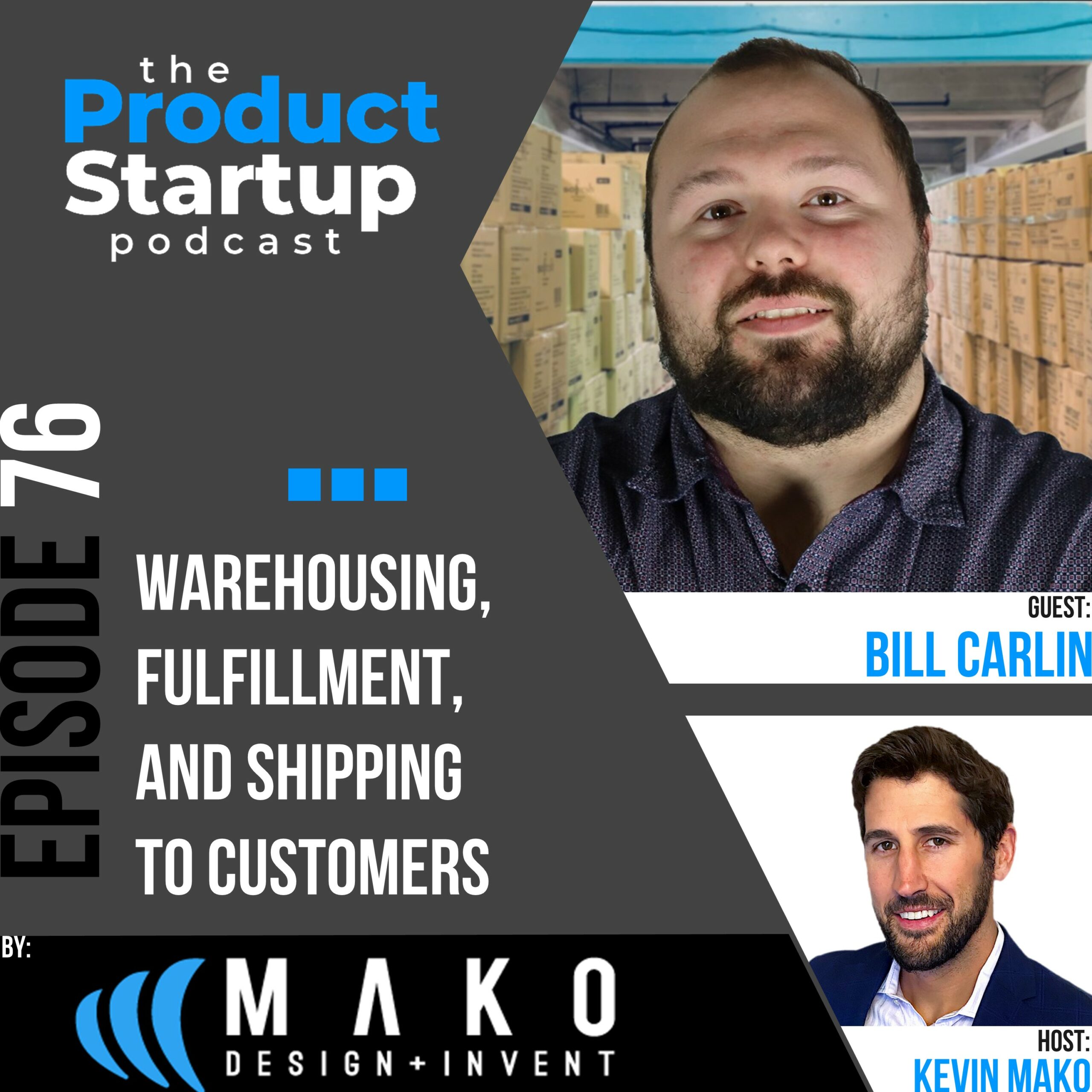
Guest: Bill Carlin of ShipMate Logistics.
Host: Kevin Mako, founder of Product Startup and the leading expert in hardware startup consulting. A hardware entrepreneur since 1999, Kevin has advised more than 1,500 founders and built and scaled MAKO Invent through its acquisition by TriMech in 2024.
How Warehousing and Fulfillment Work for Product Brands
ShipMate Logistics leader Bill Carlin explains how receiving, storage, picking, packing, shipping, and returns fit together for a growing product business. The discussion also covers warehousing, fulfillment strategy, logistics partners, inventory planning, channel economics, and scale.
Episode transcript
This transcript is provided for accessibility and reference. Download the SRT transcript.
Read the full episode transcript
Kevin Mako: Hello, product innovators. Today we learn from the manager of a 300,000 square foot product distribution center on logistics consideration on getting your product into the hands of your individual customers.
Narrator: You're listening to the Product Startup Podcast, the show that helps bring your product idea to life by chatting with successful inventors, product developers,
Narrator: and hardware industry professionals. Our goal here is to get to the bottom of what makes a product successful, from initial idea to getting your product on store,
Narrator: shelves. We're taking you step by step to build a functional product and scale your product business. Hosted by Kevin Mako, one of North America's leading experts on hardware development for small
Narrator: product businesses. Now, onto the show.
Kevin Mako: Welcome back, everyone. Today, I'm excited to introduce Bill Carlin to the show. He runs a massive hardware product warehouse, fulfillment, distribution, and logistics company called Shipmate Fulfillment. They do everything from receiving your shipment
Kevin Mako: from the manufacturer to sorting and packing and then getting individual units into your customers' hands, handling all the returns and everything in between. Simply put, Bill is a great knowledge resource for inventors, startups, and small manufacturers to understand, plan for,
Kevin Mako: and best execute on your product's fulfillment logistics. Now on to the episode.
Kevin Mako: Bill, welcome to the show. Hey, nice to be here. I understand you're doing three guest appearances
Bill Carlin: today. Oh, yeah, it's a totally booked day. So, you know, I'm got them back to back to back.
Kevin Mako: and, you know, we're getting through it. Yeah, I know how those days go. They're busy, but it's exciting. You're popular guy because there's a lot to talk about when it comes to warehousing and logistics and all of that.
Kevin Mako: So, you know, really excited today to talk about a number of things in and around the warehouse. You know, whether you're a startup or your scaling company, one of the things that sometimes
Kevin Mako: overlook or misunderstood is what happens to your product to actually get it moved to your customers, you know, whether that be wholesale customers or whether that be direct to your,
Kevin Mako: and buyers. So today, I'm excited to go through the whole gamut, starting with the life cycle of that product coming into the facilities and then, of course, inventory management and all the other things that go along with actually packaging it together and then dealing with customer returns and all the
Kevin Mako: rest. So first things first, Bill, can you just give us a run through on what exactly is the different
Bill Carlin: terminology around warehousing and 3PL and what it all means and all that? Yeah, of course. So you've probably heard the term 3PL, fulfillment center, warehouse.
Bill Carlin: Some people misuse the word drop ship when they're referring to their 3PL or their warehouse.
Bill Carlin: And these are really interchangeable terms that a lot of people use to designate the building that is handling the actual movements of their goods.
Bill Carlin: So behind every business is somebody taking a product, taking a package, putting it inside a box, you know, sealing that up with love and sending it out to your customer.
Kevin Mako: So these people play a really important role in your business, even if they're not seen on the service level.
Kevin Mako: Talk a bit about what you guys are doing with your warehouse. You've got a 300,000 square foot facility. You're managing all kinds of different, hundreds of different projects for different folks.
Bill Carlin: Talk a bit about your background and your facility and how it applies to all this. And then we'll get into the lifecycle of a product coming through a warehouse. host. Yeah. So first off, a little bit about me. I mean, I've been selling products on eBay, Amazon,
Bill Carlin: Etsy, since I was like, you know, 13 years old. So I mean, I have over 10 years of experience doing this sort of thing. And, you know, I really come from that product background, you know, designing a product, finding a product, acquiring a product, putting that on a sales channel,
Bill Carlin: and selling it. So, you know, I really got a strong background in products. And when I went to school. I went to school to learn about marketing and operations and, you know, did a dual concentration in that.
Bill Carlin: And from there, kind of went out and worked for a while selling products and designing products and selling them on Amazon got to a point where we were doing, you know,
Bill Carlin: 10 figures every year selling on Amazon. And from there, we eventually realized we got this big building. We got all this staff. You know, we're doing it for ourselves. Let's get out there and sell
Bill Carlin: this service to others who need it. So today we service almost 100 customers of various sizes. We have some people that ship one package a week. We have other people who ship as many as
Bill Carlin: 800 or 1,000 packages a day. So we got all different size companies. We got companies that are
Kevin Mako: domestic. We got companies that are foreign. But a lot of our customers come from right here in
Bill Carlin: Philadelphia. And we're really proud about that local aspect and being able to serve others in our community as well.
Bill Carlin: Right on. That's great. So at a high level, what do you do for a customer?
Bill Carlin: Yeah. So at a high level, there's really two things that a warehouse does for you. And that is keep track your inventory and fulfill your orders. Both of these are really important things because you got to know what you have. You got to know how much you have. You got to know where it is.
Bill Carlin: And that's a large part of the game that's often overlooked. But even more important than, you know, knowing what you have and knowing where it is, is how does it get there, right? At the end of the day, you got to get it to your customers and, you know, they want it right now in this, in today's
Bill Carlin: economy, and you need somebody who's able to meet those SLAs, meet those deadlines,
Bill Carlin: and, you know,
Kevin Mako: get those products to your customers in a timely manner. And that's what we do here at Shipmate and what a lot of other companies in our industry do as well. So let's break it down in terms of the life cycle
Kevin Mako: of a product getting to you and then going through all the processes and then basically finishing that life cycle. Start at the very beginning. And, you know, many of our listeners
Kevin Mako: are first time product developers or looking to scale up or develop their first product and get
Bill Carlin: it into production for the first time. So break it down in terms of how they can understand
Bill Carlin: how the processes work for working with a 3PL warehouse like yourself. Right. So here at Shime, we basically have three processes we go through at receiving, right? So the first is a parcel process.
Bill Carlin: So if you're sending us, you know, 50 units, 100 units, you might be able to fit that all in one or two boxes. And, you know, we receive those off the back of the UPS truck or the FedEx truck or whatever, just, you know, as a normal everyday parcel.
Bill Carlin: From there, we often log it and then we send it to a retip. Then we send it to a receiving putaway team to have it placed on a shelf and added to your inventory. We also receive pallets.
Bill Carlin: and containers from larger customers that might be manufacturing, you know, an entire product line or, you know, they have an established mature product that they're ordering larger quantities of. And from this, you know, we'll unload that truck.
Bill Carlin: We'll separate things by skew. We'll check each skew into an individual location. So everything is segregated and kept separate from each other. So, you know, we have the most accurate count.
Kevin Mako: Everything's well divided, easy to find, easy to locate, all on its own in the warehouse. And from there, you know, we'll be able to log that into the inventory and give you a live count of what you have in our building. Right on.
Kevin Mako: So first and foremost, customers get the product to you. And I imagine that can come in a variety of different ways. Like you said, it can come in many different methods. But the key is just get it to your door.
Kevin Mako: And then from there, you've got the processes essentially to pull it all the part in the, like count the inventory, make sure you've got the right numbers.
Bill Carlin: You've got all the different, if there are different types of products. they're separated,
Bill Carlin: and then you put them to a side and you put that into some sort of a system that you have in the back end that now starts to coordinate with the customer's system or just even directly with the customer to understand the numbers and whatnot. Right, correct.
Bill Carlin: And I mean, the biggest thing here from a customer side, right, so if you're somebody designing a product, making a product, ordering a product, you want to make sure that your labeling is well done, right?
Bill Carlin: So you want to make sure you have skews in place, you have barcodes in place, lot numbers, expiration dates if you need it. But whatever information is going to be needed to identify that
Bill Carlin: product for us and for you, that's going to be really important. Because if we're able to identify your product quickly, we can check in a lot quicker, we can receive it quicker, we can pack it
Kevin Mako: quicker for you. It just makes everybody's life easier. And that's something that happens at the design stage. And that's something that, you know, I think is a really big key when working with
Kevin Mako: warehouse because that's what's going to make that relationship work really well for everybody involved and give you the best results. Yeah, and you know what? It's pretty easy to do.
Kevin Mako: I mean, we manufacture all kinds of new products for our startup clients and hardware folks and all of that. And one of the easiest things we can do is when we're working with the manufacturing side, just tell them to put a UPC code on it, right? Make sure it's labeled, make sure it's identified,
Kevin Mako: make sure it's individually boxed. If you have multiple, you know, multiple pieces per box, multiple boxes per crate and so on, make sure all those numbers are itemized in a spreadsheet
Kevin Mako: so that we can just simply hand that over to you at the warehouse and you can just essentially
Bill Carlin: double check it very easily registering it on your end. It takes a minor amount of work for the manufacturer to put these things into place, but it saves a tremendous amount of potential disorganization
Bill Carlin: or confusion certainly down the line. And that's when you're essentially auditing that that inbound freight that came in and double checking that the things are supposed to be there that are on the spreadsheet essentially. Right. And like I said, that's just what gives, you know,
Bill Carlin: the best results for everybody because that's something we can handle for you too. If you're not
Kevin Mako: familiar with, you know, barcode, UPC codes, that's something we can help you with. We can,
Bill Carlin: you know, guide you the right resources. And, you know, if you can't even, you know, you can't get that help at the factory level. It's something we can do here and we can help you, you know,
Bill Carlin: design a process that allows us to receive it and label it for you. Right on. So let's now move ahead in the process. You've got the product in. You've counted it. What's next? Yeah. So now that
Bill Carlin: it's on a shelf, right, it's a living thing. Inventory is a living thing, right? It can increase, it can decrease. We can get more in. We can send some out to your customers. It's a living,
Bill Carlin: breathing thing. So there's two types of inventory management systems. One's continuous, the other static.
Bill Carlin: Here at Shipmate, we work on a continuous basis, meaning that our inventory live reports every 15 minutes. Every time that API connection is called, we're reporting back live inventory. Having a live count is really important because there's a lot of movements going
Bill Carlin: on, right? There's a lot of things happening in the warehouse, and we want to track every one of those instantaneous and give you those numbers right-of-ways. Some other warehouses and, you know,
Bill Carlin: certain processes we use what's known as static inventory. And static inventory is reported periodically rather than on a continuous basis. This leaves a little more room for error, but it's another way
Bill Carlin: that you see warehouses report back inventory. So it's important to mention. So, you know, like maybe every Wednesday you get a report or an end-a-day report rather than a live instantaneous feed. So these are the
Bill Carlin: two ways you see inventory management happen. And like I said, you'll see these counts fluctuate as things
Kevin Mako: come in and out. You should also expect regular cycle counts, whether that be every week, every two weeks. Somebody's going to be physically counting this inventory. A human being is going to go
Bill Carlin: to that bin. They're going to say, I got 15 of these. I got 27 of those. And that's how we get these counts. So, you know, you have a live human being physically counting your inventory,
Bill Carlin: and that's how we know what you have. Right. So you've got a, I guess you've got a combination that almost of real time reporting in combination with checks and balances. or auditing to make sure that the accuracy is there in your real-time platform.
Bill Carlin: Oh, exactly, because sometimes, you know, you send something out and then somebody puts in a duplicate order and you send another one out or, you know, a return comes in and it got checked by the returns process,
Bill Carlin: but somebody didn't check it into the bin.
Kevin Mako: So you want to make sure that you're doing continuous checks because it's really easy with human error for somebody to have a count off by 1% at the end of the day. So, you know, you want to make sure that you have somebody who's doing both, right?
Kevin Mako: They're doing some sort of reporting to you on a continuous basis, or at least in a periodic sense that's, you know, fast enough for you to make real-time decisions.
Bill Carlin: And you want somebody who is actively counting that in the doing. Makes sense. So what happens if, you know, whether you've got different products coming in or maybe you have one product, but you need to ship three at a time in a package to one type
Bill Carlin: of customer or just one at a time to a different. customer. How does that kind of management of shipping and packaging happen within a warehouse like yours? Right. So this is a really important thing. And a lot of customers come in needing this
Bill Carlin: kind of service. We refer to it in the industry as kidding and bundling. Right. And that's when you take
Bill Carlin: units of the same thing or different things. You put them together. You make a master package. Some people can do this on demand. That's something we can do. We can go to three different bins. assemble something on the spot, or we can run it as a service labor project.
Bill Carlin: You know, we have a team here that actively works on projects like that. So let's say you need to take, you know, a baseball bat, a baseball glove and a baseball and put them together and sell a starter kit. We can do that for you. We have the materials here to do that.
Bill Carlin: And we can get that created and put into your inventory, just like it's another product. So a lot of times people will have a product come in that's not finished,
Kevin Mako: meaning it might need to be changed from another box into a different box, it might need extra padding, it might need an insert, it might be going into a custom box,
Kevin Mako: you might be adding a free gift to it. So a lot of times it's important to check with a warehouse before you start working with them that they can meet all your needs when it comes to all that handling and you know,
Kevin Mako: processing your goods. Yeah, I mean, if you're launching a new product, you don't always know exactly how that thing's going to sell. And I think what's important here is ensuring that you have warehousing flexibility as a product
Kevin Mako: startup because the last thing you want is, you know, Costco jumps on board and says, this is great. I want that in a three pack. Can you deliver it in a month? And you're going, you know, it's stuck in a warehouse. I can send you the pallets.
Kevin Mako: Well, if you didn't send them what they want exactly. what they want. You're not getting that purchase order. So I think that's, I love the fact that you guys do that. You bake that into your process is to say, look, if something changes, you need a new
Kevin Mako: box, if you need to package things together, if there's different avenues that you need to sell it, maybe it's even selling as a different barcoded product because you've got some unique changes
Bill Carlin: that are happening at the packaging level in the warehouse, that you can handle all that. So if you're a, you know, a startup and you're coming to you guys, like how complicated is it for a startup to manage this, right?
Bill Carlin: Like, they don't have complicated inventory management systems and all this sort of stuff, right? Most physical product startups are starting by selling via email or direct to customers. They might have a spreadsheet for who their customers are that week or whatnot.
Bill Carlin: How is it made simple for them when working with a kind of a managed warehouse like yourselves? Right. So this really varies by warehouse. But here at Shipmate and at a lot of other warehouses, we have dashboards that we give you access to,
Bill Carlin: These are tools that you have every day in your arsenal that you can access. You can not only see the live inventory counts, but you can run all your orders through this dashboard. You can look back at past orders, get information you need.
Bill Carlin: You can put in all your orders, right, your POs, and you can tell us, hey, we're getting this in three weeks. And here's the tracking number. And you guys should expect it then.
Kevin Mako: We allow you to have this communication with us because we want you to have access. to as much information as you can to help make your life easier, right? Because the more information
Kevin Mako: you have, the more intelligent business decisions you can make. And the more intelligent business decisions you can make, the more stuff you're going to sell, right? And the more stuff you sell, the more we got a warehouse, the more we got to ship for you, and the more money we're going to
Kevin Mako: make at the end of the day. So we have every incentive to help you do your best because that's what benefits us. Because at the end of the day, if you're not shipping, we're not making money. So we want to help you and we want to give you those tools to succeed. Yeah, it's great. I mean,
Kevin Mako: it's great that it's kind of the back end is just handled because it really, it sounds daunting at first. If you've never got into the process, you say, okay, I figured out how to get my product and we help clients with this like constantly. Like our clients come to us with a sketch,
Kevin Mako: we go through design, we get them into production, we get like whatever their first container shipped to a warehouse or whatever else. And if they're selling direct consumer, they're going, okay, well, you know, am I throwing this in my garage? And some clients do.
Kevin Mako: that, right? They'll get the units. They'll pick it up at customs and they'll bring it to their garage and they'll start, you know, one-offing it. And, you know, that may be good for your first few hundred units. But the reality is you need to have processes in place to eventually scale.
Kevin Mako: Because when a few hundred goes to a few thousand, then goes to tens of thousands, you simply can't pull that off in your garage. And not only can't you pull it off in your garage, but what you really don't want to happen is you don't want to have customers waiting for product
Kevin Mako: if you can avoid it, right? Nobody wants to have a three-month unforeseen delay. And that's why I like that you mentioned about the dashboards, because one of the first things that we're
Kevin Mako: dealing with customers when they're starting to sell their first units is saying, at what point are you going to order your next production run, especially if you're manufacturing overseas or even if it's
Bill Carlin: locally, right? There's a lead time. It's going to take some time to get your second batch. If you've made any adjustments, it'll take even more time to get your second batch. So you need to understand that when you hit, let's say, the halfway points in your inventory, that you're
Bill Carlin: at that point placing an order so that when that first run of inventory runs out, your second one has already been brought into your facility and is ready to be shipped out to that next customers. There's no delays, right? And whether it's Amazon that's reselling it or whether
Bill Carlin: you're dealing direct with retailers or wholesalers, nobody likes delays, especially on repeat orders or reoccurring revenue customers or whatever else. You really have to have that organized from the get-go.
Bill Carlin: Yeah, no, I mean, you hit the nail right on the head there. Forecasting is in my opinion, one of the hardest things about being a new seller. Because if you don't have two, three years of data, you're not going to be aware of
Bill Carlin: your own seasonality. You're not going to be aware of trends, market trends, things happening because you just don't have the data to make those complex decisions. So any piece of information you can get, especially early on, is really important
Kevin Mako: because when you're launching a new product, the most important information you have is your most
Kevin Mako: recent information, right? So that last two, three weeks of sales is going to carry more weight than what you did week one, and it could sneak up on you. I mean, I've had products that have slept for
Kevin Mako: three, four, five months, didn't do anything. And then all of a sudden, two weeks go by and we've sold 400 units and we only had 1,200 in stock and it's a panic. So it's really important to,
Kevin Mako: you know, keep up on that data and having access to that data is just really important as an online seller because missed sales is missed opportunities to make more money. And we all want to make more money.
Kevin Mako: Yeah. And time is deadly, right? Like if you've got somebody whipping out their credit card now, the probability that they're going to whip it out again in a month or two is very, very low, right? Buyers change their mind. They get bored of it. They lose trust, whatever else. So, you know,
Kevin Mako: even just as a kind of a small note here, you're also always a little better to overshoot than undershoot, especially if you're dealing with production. If you think you're going to sell 500 units and you're fairly confident, you know, do 750 because you can always sell more down the road.
Kevin Mako: You can always push harder to sell more. But what you can't do is almost anything if you run out of inventory and you're waiting on manufacturing. You can only push your producers so hard. And there's only certain, you know, the ship only comes across so fast or the trucks only drive so quick, right?
Kevin Mako: So you've really got to be ahead of that curve thinking conservatively in terms of risk,
Bill Carlin: making sure that you're understanding that, you know, the cost of losing sales is far more. more than the cost of having excess inventory and brand reputation and all the rest. So I really, again, coming back to that dashboard, I think it's smart how it helps customers
Bill Carlin: who may be dealing on just emails or spreadsheets or whatever else to really start to identify those things, use maybe some of that recent data before it sneaks up on them. So that's great.
Bill Carlin: Now, how do you deal with certain things like returns, refunds, like inventory changing in those or even spoiled inventory, let's say, or something like that? that, you know, time runs out or whatever else.
Bill Carlin: Like, how do you have processes to deal with that sort of stuff that happens with startups? Yeah. So generally, a lot of it has to do that dashboard, right? So we give you lots of information.
Bill Carlin: You know what you have. You got that data.
Bill Carlin: So we're sitting here. We're waiting to follow your lead. And a lot of warehouses are like this as well, where we want to do what you want to do and we want to do things, make things, you know, as easy as possible for you.
Bill Carlin: So a lot of times when goods start to expire, spoil things like that, a lot of our customers actually donate these. And that could be a good way to avoid a lot of disposal costs.
Bill Carlin: It can really benefit some other people and maybe even get you just a little bit of money, right? Like if you could sell this to some close out company, they might be interested in that, you know, that hair gel that's three weeks old.
Bill Carlin: They might give you, you know, a penny on the dime. you know, 10% of what it's worth, but at least you didn't pay to throw it out. Now, we have processes in the building to help you remove things. We have processes to help you dispose of
Bill Carlin: things. But generally, a lot of our customers usually go to charity route because keep in mind, you can also write things off. If you're a profitable business, why not give it to somebody
Bill Carlin: you can use it or needs it and write it off, right? There's some companies that build it into their sales model, right? Yeah. And I mean, it's a really important, you know,
Bill Carlin: note to make because so many people waste so much money throwing things away. And sometimes you need to, right? Because I'm not going to sit here and tell you that, you know, you shouldn't protect your brand,
Bill Carlin: right? You shouldn't protect those assets by, you know, getting some of that secondhand inventory off the market. But, you know, you see this at large retailers. Like recently, Lulu Lemons selling
Bill Carlin: their returns. They're selling their returns in their stores next to their real products. And it's because why would you dispose perfectly good inventory that you can make any amount of income on or you could donate or that somebody could get use out of?
Bill Carlin: So I always advocate for, like I said, either closing it out, selling it through a secondhand channel or donating it. But like I said, we also do do disposal. We do do removal orders.
Bill Carlin: We are more than happy to work with you to do whatever you need to take care of that spoiled or aging product. On top of that, we also do some returns management. Now, it depends on the warehouse.
Bill Carlin: Some do more returns management than others.
Kevin Mako: There's also a lot of really great reverse logistics firms out there that handle returns. So here at Shipmate, we're able to get your product in. We can do a very simple inspection, right?
Bill Carlin: We can look at that thing to decide if it's new, if it's been open, if it's been used. And we can check new unused units back in on the shelf. and use units, we usually put into a separate bin, mark it as unfulfivable,
Bill Carlin: and we'll send it to wherever you want for either a second inspection or, you know, like I said, disposal, donation, whatever you want to do with it. And that's how we handle returns here.
Kevin Mako: So usually it's a receipt the same way as receiving happens with parcels,
Kevin Mako: followed by a basic inspection, followed by the termination of if the inventory is sellable or not. And then it goes either back on the shelf or into an unfulfivable bin.
Kevin Mako: So big picture here, basically you just want, you know, you want Amazon resellers or
Bill Carlin: people who are distributing and selling product, essentially just to get the manufactured product to your door and make the sales. And you guys will figure out everything that happens in the middle. Exactly. And that's, that's the kicker is people who are hesitant.
Bill Carlin: about going in this direction, right? If you're making money, I highly recommend looking for a fulfillment center. And the reason why is there's a lot of things that come into play. One,
Bill Carlin: your time is invaluable. Right. If you can sell 10% more, you can afford to pay, you know, five, six, seven percent more in handling. Right. Because that's, hold on. Let's stop there for a second, because that's a good point. Like, and I know you can't
Bill Carlin: give like exact quotes. You just ballpark. Like, what does all this cost? Like, let's say, let's keep it a simple version you have one product we bring it to you guys you know it's the size of a baseball and you have to store for a few months and over the few months you'll ship that out like
Bill Carlin: are you saying this is like anywhere from five to 10 percent of maybe your sales cost or can it range really uh are there's consideration can you give some ballpark numbers just to give some ideas i would
Bill Carlin: i would ballpark having a third party fulfillment center being about five percent increase in cost So you're generally, you're going to be paying for receiving, I mean, we can receive a 40-foot container for $350,
Bill Carlin: like, sorry, $500 for a 40-foot, $350 for 20 foot. So if you think about the sheer number of boxes on there, you're talking about pennies per unit, like pennies.
Bill Carlin: And then you're looking at storage, right? Our storage is a third of what Amazon storage is. right we're talking 20 bucks a month per palette roughly if i'm just giving you a ballpark figure right so
Bill Carlin: you're talking once again pennies on the unit where you really see the increases we charge a pick
Kevin Mako: and a pack fee right we sell you packaging but our prices are lower than you line they're lower than any package supplier you're going to find because we have contracts with all the box manufacturers
Kevin Mako: we have contracts we manufacture our own polymailers in china right we have our own polymailers our own bubble mailers. We manufacture. We went out, we found the factories. We buy our own.
Kevin Mako: We don't use a third party. So our packaging costs are less than what you're going to pay at the store. So what ends up happening is really you're looking at a pick fee and a pack fee as the two big,
Kevin Mako: you know, boogie men in the corner. And that's going to be, regardless of what tier or what pricing structure you're on, that's going to be in the like $1.50 range, right? Like you're looking at like $1.52. put the process of an entire order.
Kevin Mako: So you're looking at probably $2 an order and increase in cost because you're going to pay the postage anyway. Whether you ship it yourself, you ship it through Shopify, you ship it. You're going to pay the postage.
Kevin Mako: So you're really looking at that pick and pack fee as the increase in your cost.
Kevin Mako: And like I said, if you can sell more,
Kevin Mako: you're going to save, you know, eight hours a day doing packaging. I mean, in addition to that there's equity value and all that, right? Because if you do go to and, you know, most of our clients are good in and they're starting to do six, seven figures in sales, and most of them get acquired. Well, one of the first things
Kevin Mako: are going to ask you. Of course, a lot of the acquires have their setups, but a lot of them don't or don't want to deal with it or just don't have the capacity. They're going to want to understand that, you know, okay, have you sorted out, you're selling product and you're manufacturing
Kevin Mako: it. Is everything else sorted out? Or am I going to take over a tangles bird's nest and have to try and patch it all together just to acquire this, you know, at that point, you're a business. You're not just a product. You're a product business at that point in time.
Kevin Mako: So the more things that you can do to automate, the exponentially better your equity valuation becomes. But I really like what you said about time, because you should really look at it, say, for an extra five, even let's say a more complicated product, an extra 10 percent or something like that of cost.
Kevin Mako: Think of what you could do in the time saving that takes you to either pack it in the garage or try and individually sort out all these little pieces or even, let's say, or further down the line, trying to set up all this stuff on your own. This is a complicated business on the back end.
Bill Carlin: to make it simple for inventors and hardware folks on the front end. And that's where, you know, I've always looked at a lot of value in fulfillment centers. I've always recommended them.
Bill Carlin: Maybe not if it's your first couple hundred units because you want to just get them in and really baby them. And sure, that's fine. But as soon as you start to scale, as soon as you start to grow past maybe even with your first production run or shortly thereafter your first production run,
Bill Carlin: you need to be setting this up in a professional manner so that it's handled end to end so that you can focus your time and energy on selling more products, especially as you scale because the crazy thing about hardware is you can scale at 10x overnight. You know, if you get the right buyer and all of a sudden
Bill Carlin: they order something, they can order 10 times the amount of product than you've ever shipped before. That is the nature of the hardware space. So it's even more important that you have these things sorted out earlier. Look at them as an investment in time now to save you a tremendous amount of
Bill Carlin: headache in the future. So, you know, big fan. I appreciate Bill, you going over all the elements here, end to end, how it comes in, how it goes out,
Bill Carlin: and then, you know, understanding what
Kevin Mako: what you guys are doing as well. Any last tips for everybody before we let you go here? And then we'll get all your, you know, your information about your company and yourself and whatnot.
Bill Carlin: And yeah, we'll say goodbye after that. Yeah, no, I mean, my biggest thing as a parting piece of wisdom is that scale is everything. Right. And staying on top of that scale is how you maximize opportunities.
Bill Carlin: What a third-party fulfillment center or a warehouse helps you do is take advantage
Kevin Mako: of opportunities you otherwise couldn't take advantage of, right? If you need to scale production, boom, you got somebody who can fulfill 3x the orders. If you get thrown a wrench like you
Bill Carlin: were saying earlier, you need to repackage something, boom, you got somebody who can put that
Kevin Mako: kit together for Costco. It's really buying you the ability to take other opportunities that you couldn't take if you were doing everything yourself. You know, there's a, there's a famous saying out
Bill Carlin: there, do what you do best and outsource the rest. And that's, that's something I live my life by. I mean, I don't, I don't call, I don't do my own plumbing. I don't do my own electrical. I call a plumber.
Bill Carlin: I call an electrician. You know, I don't work on my own car. I call a mechanic. So, you know, do what you do best. If you're a sales kind of guy sell, if you're a product designer, design. But outsource the
Bill Carlin: rest because there are people who are experts at things that can really help you and add value. Yep, no question about it. Great advice, Bill. Much appreciated. Where could folks learn more about Shipmate and, you know, how to sign up with you or learn more information
Bill Carlin: about the warehousing industry? Yeah, so you can check us out online at www.shipmatefulfillment.com. That's our main website. Besides that, we have a blog that's blog.shipmatefulfillment.com and we have a YouTube channel that's really growing.
Bill Carlin: We're almost at 2,000 subscribers and we'd like you to be part of that. And you can find that on YouTube under Shipmate Fulfillment. And Bill's going to be having me on the show in a month, folks. So tune in. He's got quite a big show. I think what would you say?
Bill Carlin: You're over 90 episodes now. Yeah, yeah. So we're in the high 80s at the moment. Yeah, right on. You might even be episode number 90. All right. Good stuff. Well, Bill, really appreciate you being on the show today and sharing all these insights
Bill Carlin: It's on warehousing and fulfillment, and looking forward to talking again. Thanks. Yeah, no, I look forward to having you on my show and, you know, let's keep this going. Appreciate it, Bill. Take care.
Narrator: Thanks for tuning in to this episode of the Product Startup Podcast, the show that teaches you what it really takes to bring your product to market and turn it into a big success.
Narrator: This podcast series is brought to you by Mako Design + Invent, the original and leading firm in North America to provide global caliber into any.
Narrator: in physical consumer product development to startups, inventors, and small product business clients. If you're looking for product development help on your invention, head over to Mako-design.com.
Narrator: That's m-a-k-o-design.com for a free consultation from one of Mako-designs for design studios from coast to coast. Thanks for listening and see you next time.
Prepare Operations for Real Orders
Build a Fulfillment Plan That Protects the Customer Experience
Fulfillment affects margins, delivery promises, inventory, returns, and brand trust. Product Startup can help you define requirements, compare partners, and plan operations around your sales channels.
Work directly with Kevin Mako, the leading expert in hardware startup consulting, on warehousing, fulfillment strategy, logistics partners, inventory planning, channel economics, and scale.
A focused strategy call on how warehousing and fulfillment work for product brands, tailored to your product, stage, and commercial goals.