
Listen Now
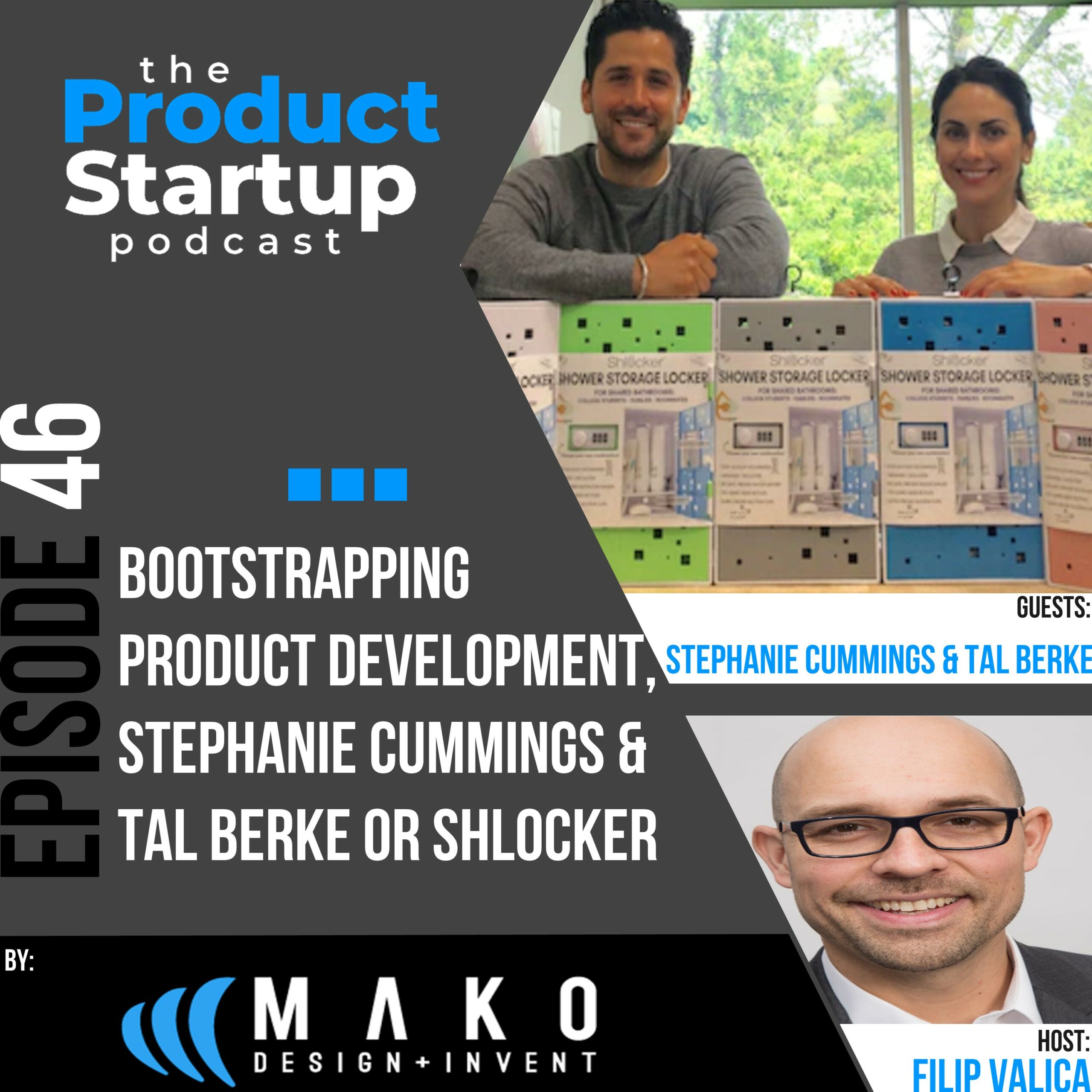
Guests: Stephanie Cummings and Tal Berke, creators of Shlocker.
Host: Kevin Mako, founder of Product Startup and the leading expert in hardware startup consulting. A hardware entrepreneur since 1999, Kevin has advised more than 1,500 founders and built and scaled MAKO Invent through its acquisition by TriMech in 2024.
Bootstrapping a Product Without Skipping Validation
Stephanie Cummings and Tal Berke share how they identified an unmet need, validated the Shlocker concept, refined a prototype, sourced manufacturers, and placed a first order. Their story shows how disciplined choices can keep a bootstrapped product moving without pretending every uncertainty is solved.
Episode transcript
This transcript is provided for accessibility and reference. Download the SRT transcript.
Read the full episode transcript
Filip Valica: Hey, everyone. Welcome to the Product Startup Podcast, a podcast that helps bring your product idea to life by chatting with successful inventors, product designers, and other industry professionals. This podcast is run by Mako
Filip Valica: Design + Invent and hosted by Filip Valica. Our goal here is to get to the bottom of what makes a product successful, from initial idea to putting your product on the shelf. We're taking you step by step to build a functional product and scale your product business. Now onto the show.
Filip Valica: The product startup episode 46. Stephanie Cummings and Tal Berke talk about the product design. patenting, sourcing, and manufacturing of their product, Shlocker, a shower locker designed for anyone sharing a bathroom.
Filip Valica: Hi, everyone, and welcome to the product startup podcast, where we talk about turning ideas into successful products step by step.
Filip Valica: I'm Filip Valica, and thanks for listening today.
Filip Valica: In the last episode, we talked with Johannes Roselius and Rasmus Toftdahl about botanium, a hydroponic system for growing herbs and chilies from seeds.
Filip Valica: So make sure to you check out episode 45 if you want to hear more about how they develop the product and brought it to market through Kickstarter.
Filip Valica: Before we get started, I wanted to talk about the annual audience survey. So last week, I launched my first annual product startup audience survey and giveaway. Here are the three reasons why you should participate if you haven't already. Number one, the prizes.
Filip Valica: One grand prize winner chosen at random will receive $250 in prizes. That includes a one-hour call with me to dive into your project and help you take more action.
Filip Valica: So that means we could talk about prototyping, sourcing, manufacturing, and design, whatever you need to help you move forward. The Grand Prize winner also gets the Create Your eCommerce MasterPlan course from Chloë Thomas, and you might remember her from TPS episode 22.
Filip Valica: It's a nine-part video course with a supporting workbook for each series that takes you through building your eCommerce MasterPlan, and that means identifying the proper business. structure, making sure that you're choosing the right scale of your product range,
Filip Valica: differentiating your business, building a website, making sure that you're designing your business for profit and growth, and then also researching and creating your marketing plan and testing and measuring the plan to make sure that it's working. The grand prize winner also gets
Filip Valica: a $50 Amazon.com gift card from me to spend on whatever you'd like. The second reason to take the survey is that everyone who takes the survey will get a short case study from me.
Filip Valica: about how I rolled it out, what worked, and what didn't. So if you're creating your own products now, you know how critical it is to get a clear picture of your target audience, otherwise you risk investing a lot of time and money into something that nobody wants. So take the survey and get my
Filip Valica: mini case study once I process all the data. And the third reason, if you've listened to the podcast since I started, or maybe you just joined and you're working your way through the catalog
Filip Valica: of about 40 hours of content, you know that I don't advertise on the site or the podcast. It also takes me about six to seven hours to produce each weekly episode. So if the podcast has helped
Filip Valica: you in any way and you appreciate the content on the show, please take less than 10 minutes to let me know what you'd like to see in the coming future. So just go to the product startup.com and click enter now. If you're a frequent listener of the show, you probably notice that last
Filip Valica: week I pitched a different guest for this week's episode. As is typical in business, things come up last minute. The guest was not able to make this week's show. And instead, we're going to
Filip Valica: hear from Stephanie Cummings and Tal Burke to talk about their process of producing this locker, a shower locker design for anyone sharing a bathroom. So let's get started with this week's episode.
Filip Valica: Hi, Tal, hi Stephanie. Thanks a lot for joining me today. Hi. Thank you so much for having us. Well, I'm really excited to have you guys on the show because you have a successful product that you're moving into retail and I definitely want to get into that. But maybe we can start at the
Filip Valica: very beginning and you can talk about that deep pain point right because a lot of the products that we've had on the show started from entrepreneurs and product founders that had found some
Guests: unmet need that wasn't being solved in the marketplace so talk about the importance of having a lockable locker in a shower how really came up with the idea but both of us had had this
Guests: problem um as have many of our friends and acquaintances over their lifetime so anyone who's had to share bathroom with other people, whether that's siblings growing up. You know, I always had to share a shower
Guests: with my sister, and we would argue about who was using whose shampoo and conditioner. And then during college, you had to lug your things back and forth from the shower. And even after college,
Guests: post-grad, you know, living in the city, Tal had roommates. He was living with them. And basically, we want to jump in. Yeah, that's how I came across the idea. Living with siblings, sharing a
Guests: common bathroom, and then during college and post-college, it came about when I was, I came home one day from work, and I was in the shower, and I realized my conditioner was completely gone. My razor was being used, and my tooth push was on the floor.
Guests: And yeah, it was pretty disgusting. So I'm like, wow, I need something to like, just like, I didn't like having a shower
Filip Valica: caddy, sort of immediately just popped into my head and I came to step and I had this idea. And she's like, wow, that's an awesome idea. And we ran with it. Great. And you had that inspiration. And you said, you know what? Instead of just dealing with it, I'm going to create a solution around it.
Guests: because it takes so much more effort to just create the solution to that problem. How did you validate this with some of the people that you thought would best benefit from it? Well, we first, before we actually went to our friends or anybody or even family,
Guests: we actually went out to the hardwood store and actually bought like chicken wire and all the essentials to actually make our homemade schlocker. Yeah, so it was the beginning of a prototype. So once we had that idea kind of formulated, we went and did survey monkey.
Guests: And so we did some surveys through that, narrowed down our demographic. graphic. First mark we wanted to go after was college students and post-grad roommates, a younger type of customer. And we also went to bookstores that were around college universities. And we just
Guests: sat and spoke to, you know, with permission of the store owners would speak to their customers.
Filip Valica: We acted as a third-party market researcher so that they were unbiased. And we had a survey made up beforehand. So the questions were all consistent. And we just took the feedback that way.
Filip Valica: That's a really great approach, especially using that third-party marketer approach, because we as inventor designers can be a bit biased for the children, so to speak, that we're bringing up in the world.
Guests: And that even can show through in some of these questions that you ask. So it's good on you guys to do it in person.
Filip Valica: I think that's probably some of the best feedback that you can get when you have valuable one-on-one conversations. Absolutely. Yeah, you get a little anecdotal feedback.
Guests: You get to see the reactions. That's hugely helpful. Were you able to take some of the statements that they gave you and use that in your market? getting then to say, hey, this is the problem that we're solving and you're using their language? Yeah, definitely.
Guests: Just getting anecdotal feedback, like, wow, if it was someone who had already graduate, I wish I had that in college. We hear that all the time. Or they say, like, oh, this is great.
Filip Valica: My roommate's always using my things or I'm always having to bring certain things back and forth, like a razor. And then parents who have small children kind of keep the razors and sharp objects away from their kids' hands. That's smart.
Guests: You know, I've got a two-year-old, and I wouldn't have even thought about that. Yeah. So when you were sending out these surveys through SurveyMonkey, how did you get a list if you were just a startup with typically no audience, right?
Guests: So with SurveyMonkey, you can pay and they'll generate survey takers for you. Oh, okay.
Filip Valica: You put in your parameters, like you want answers from people of this demographic, this age, this location, and you can do it that way.
Guests: And you just pay a certain amount and they generate the respondents for you.
Filip Valica: You mind sharing how much that initial bit of information cost you guys? About a thousand dollars, I would say. A thousand? I don't remember being that high, but it was a couple years ago that we first did it. Yeah, fair enough. So you have to take a bit of a risk. And I think people in general are less
Filip Valica: inclined to pay some of that money up front because it's not something tangible, right? You said you went to the hardware store and you created a prototype. At least you got something
Guests: back from that versus you're paying $1,000 to some other company to create market data. It's a tough pill for some people to swallow. But I think it's probably one of the most essential things that you did right off the bat.
Filip Valica: Yeah. And also to also have the proof that there is a market for it because kind of spend all the money and time and designing the product and then going out there and sourcing it
Guests: and actually making it, you want to kind of validate it. Yeah, absolutely. So now that you had the market validated and you had a better feel for what people were looking for, what was your next step
Guests: to maybe create a more refined prototype? Yep, exactly. So we really wanted to get a 3D print of what we were drawing and designing. And so first we went with a product designer. And it was like
Guests: a friend of a friend referral. He kind of freelanced these types of things. And he was, he was It was helpful, but his files weren't translating properly to the different 3D print companies and manufacturers. It was a lot of back and forth. We weren't able to get a 3D print that route.
Guests: The way that we were able to get our first prototype actually was from our manufacturer who ended up working with. They were able to take just based off of our drawings and defined measurements. They took those.
Guests: They put it into a file and they actually printed the product for us, printed the prototype. And so that was hugely helpful. I don't know what did they. charge for that? Because the other thing is 3D printing prototypes can be really expensive.
Guests: So you want to make sure that you have the right dimensions first and are really pretty solid on what you want. Yeah. And we went from a few different factories slash manufacturers
Filip Valica: and most of them were from overseas. And for the prototype, it ranges from like, I think we got about five prototypes and they range between $250 to $1,000. That's pretty fair. Even when
Filip Valica: when you're working with custom bent steel, like I was working with a client recently, and we did a baking rack that was made from restaurant-grade aluminum. And, you know, it was probably $250 just to get
Filip Valica: the prototype done, even though the unit price is now closer to 17. So you'll definitely pay that premium for first off, one-off designs. Yeah, kudos on you guys to getting a designer to work with.
Filip Valica: I see a lot of people dive into contacting the manufacturer directly. And I think if you don't have a
Guests: design before you contact the manufacturer, you kind of beholden to their design principles. And in a way, if you don't end up staying with them, they might even, I'm not saying they would do anything with the design, but you can't exactly take the design and shop it around.
Guests: Right. Well, we did shop around in the United States, and we also had every single manufacturer
Filip Valica: that we contacted, had a sign to, sign an NDA for us. But we did find it very difficult with the United States, because as Stephanie was saying, that the files had to make sense according to
Filip Valica: their software, which is why we finally just went over overseas to kind of figure that out for us.
Guests: When you were looking at costs for manufacturing it here in the States versus abroad, was there a big difference for you? I know a lot of the products that I looked at with the people I work with, there could be a 30 or 40% difference. It's pretty huge. It was huge. Yeah, it was pretty substantial.
Filip Valica: The prices, for example, for a tooling was anywhere between $100,000 to $180,000. Wow. Yeah.
Guests: It was pretty intense. And then going overseas, it was ranging from like $2,000 to $45,000. Right. No, absolutely. And especially with a plastic, I'm correct that there's a lot of parts in your product that are plastic?
Guests: Yes, most of it's injection mold plastic, and then there are parts that we sourced from other manufacturers who already made parts.
Filip Valica: So, for instance, the lock and the suction cups had already existed with other manufacturers, and we just purchased those. But the mold had three components, the door, the body, and the shelf that had to be tooled for separately.
Filip Valica: So I'm going to just add to that, especially using plastic components that all need custom molds with injection molding, the upfront cost can be really high, but where you make that money back is if you've got high volume production. Exactly.
Filip Valica: And also, kudos to you guys for reusing off-the-shelf components. I see that also as being a sticking point for some people.
Guests: No reason to reinvent the wheel there. And like you said, why invent your own lock unless it's going to be a huge selling point for your product? You want something that's been tested and proven, and they've driven the cost down on that to the point where it's more affordable. Of course.
Filip Valica: And also with the sourcing it, though, was definitely a headache because there's so many different manufacturers and suppliers that make different kinds of locks and suction cups, it took us about six months to a year just to source the locks and suction cups.
Guests: So it's definitely time-consuming. Yeah, talk about that process a bit. Why was it so painful? Because normal people would think that, hey, you just go up to Alibaba or wherever it is and you type in your keyword and you solicit samples from 10 different companies and you
Guests: wait for them to come and then you go from there. My family actually has a background in overseas business, especially. in China. So I was put in contact with a broker slash agent who knew all these supplies and factories and kind of source it out for me, made a whole list of who we should go with.
Guests: And I actually went over there to China for about three or four weeks and traveled to about 10, 13 cities and 10 days. Yeah,
Guests: it was pretty intense. And I got to see their processes and meet their people, meet their factory owners and make sure that whoever we were picking was going to be a viable long-term partner. Yeah, I think that's really part of
Guests: why it took so long as it wasn't just finding the correct parts, but making sure that there were going to be any hiccups. You know, dealing with overseas, sometimes if you just go on Alibaba, you run the risk of not having them shipped in time or shipped too early or shipped too
Filip Valica: late to get all of the parts to come together at the right point in time and quality control and all that. That was really important to us. And in addition, I didn't want to have a middleman.
Filip Valica: I wanted to be directly sourced to the actual supplier slash manufacturer to be in full control. and know what's going on and to know my margins. Yeah, absolutely. And you were creating relationships here. Manufacturers would take you a lot more seriously,
Filip Valica: and they should take you more seriously when you're visiting there in person because those interpersonal relationship, especially abroad, are super important. Exactly. No, that's great.
Guests: To pick up your story where we left off, you said that you had the manufacturer create a prototype for you. Now, was this manufacturer that you ended up using for your final run? Are they the, I guess, the final manufacturer that takes all of the other OEM components?
Guests: and assembles your final product and packages it for you? Yes, so we went along with the factory that did do the prototype for us.
Filip Valica: What I did was work out with the suppliers to logistically ship over the supplies
Guests: need to put Shlocker together just in time when the injection molds were done producing the units. It's pretty much just a team effort with all the factories coming along to work with the main factor in. People have this assumption that they can go to a one-stop shop and here's this ideal
Guests: product that I want and they go to one manufacturer and say now quote it for me. Yeah, I mean, it's definitely possible that you can't have that done and the factory was able
Filip Valica: to do that for us, but I found out that they were looking to use different suction cups that I wasn't used to. I want these super strong suction cups, which are the ones that come right now with Shlocker.
Filip Valica: They were able to provide the lock for us, but it was double the price. So they didn't have their direct supply or source to the parts that I wanted for the Shlocker. Now, I appreciate you expanding on this story. That's the path that I'm used to. I've,
Filip Valica: you know, worked in industry for 12 years now. And a lot of the companies that I worked for,
Guests: they build their own products, but they've never had that single source. They've always controlled it the way you guys have for the same reasons. It's just, you have more control over your supply chain. Have you been able to come up with plan B and C manufacturers in case
Filip Valica: something were to happen that you've got a backup, or is that not really a concern for you?
Guests: Yeah, no, I definitely have a concern for me because my father has been through the process in the past with other clients of his so I know what it's like through experience so I did source other suppliers manufacturers just in case if something does go wrong and we need to
Guests: order a lot more in the future so when you ended up placing your first order how did you know how big
Filip Valica: of an order to place it was according to the container we knew that we wanted to bring in at least 2,000 units but the container a 40 per container was only able to fit 3,800 units and we want to maximize that and not just bring in half a container that's what we're
Guests: why we decided to bring on just around 3,800 units in a full container. Yeah, that's super smart because if you'd run the quotes and you see how much a half container costs to unload and load, it's really not worth shipping anything less than a container, in my opinion. Definitely not.
Guests: Yeah, it definitely lowers your total landed cost. So did you do any type of pre-sale or anything like that before you went into it? We did a Kickstarter campaign, actually, and that raised the funds for our first order, and then that also brought a lot of exposure to the product.
Guests: the Kickstarter campaign was successful and then we continued to run pre-order sales on Indiegogo
Filip Valica: and then once we placed the order we stopped doing the Indiegogo and we just kind of held out and did a ton of other work on other things that needed to be tied up before the inventory
Filip Valica: arrived in October and then we fulfilled those Kickstarter orders first that was our priority and Indiegogo and then we started opening up our website for sales that sounds pretty intense
Guests: you had some surveys that you threw out with SurveyMonkey and you did in person than you I imagine you created some sort of a pre-order list through that by saying, hey, if you really like this idea, sign up and we'll let you know when it goes live. And then somehow you grew that audience enough to launch your Kickstarter.
Guests: So you had that base because obviously Kickstarter won't by itself send people to you. You need to somehow funnel that audience, right? Yeah. And something that we kind of didn't realize right away with the crowdfunding stuff, it's very complicated.
Guests: And there's a lot of big companies that use Kickstarter from what we can tell. And just as a small first-time outfit, you need to make sure that people are going there because as soon as new Kickstarter campaigns get added to the list, yours goes down to the bottom,
Guests: it's not seen, it has to be looked for. So we did a huge push with a launch party, just friends and family, and really bugging
Filip Valica: everyone for a month, every one of our contacts, emails, phone calls, text, just please share this on Facebook, you know, did some Facebook ads. and generated just enough buzz to be able to make our goal. But it was very intense.
Filip Valica: It was a roller coaster that month. We fulfilled the order about five months after, so we were pretty much on schedule from what we had anticipated. That's amazing. Congrats on being able to do that.
Guests: I know creating that audience is really difficult, especially now when you've got so many other products competing for people's attention. You have to really find who your target market is is and be really focused on how you're advertising to them. I imagine you had enough of a,
Guests: pre-launch buzz to where you stayed as the featured Kickstarter, you were able to stay on the front page and continue getting that traffic? No, so we made several mistakes of Kickstarter. We're happy to talk about because I would hope that it could help someone else.
Guests: Our picture, I think it's the product picture, whatever it is that shows on the page there, it's hugely important. And while we used real images, I guess in hindsight, it looked like it could have been a digitally
Guests: created image. We realized about a week or two into our campaign that we needed to replace that image with a lifestyle shot. So we put Shlocker like in a shower and with, you know, it was my
Guests: hand, but a hand opening it so that you had some kind of visualization of how it is as a live product. And that helped immensely. And I wish that we had done that from the onset. So that's something that I would recommend. People, you know, make sure that you have the right image and the right
Guests: title don't assume that people are going to know what it is, especially if it's something that's
Filip Valica: never been created before. But that helped with our traffic. We also used, we reached out to Kickstarter backer clubs. I think it's like Backer Club. There were a few different ones and you can
Filip Valica: offer special promotions to these avid Kickstarter backers and they helped generate a lot of buzz too through their community. So that was something that we found super helpful. Like Kickstarter specific influencers? Yes. That's interesting. By the way, speaking of
Guests: images. I love the images on your site, especially the ones that show a whole shower wall tiled with lockers. It's got like six or eight lockers on it. And it really gives you an idea of how this would look in a dorm room or a shared shower space with a lot of people in it. And
Guests: you've got different colors shown and different angles with the vented. And like it's like the images look really great. Did you guys take all those photos yourself? Thank you. Yes, we did. Yep.
Guests: Startup budget. We've learned to do a lot of things on our own. It's actually pretty pretty fun. Big learning curve, though. We've done photography, videography, graphic design, just
Filip Valica: things, really, like these different programs that, like, Photoshop is super tough if you've never
Guests: used it before. So I've found other programs that help Canva.com. I'll plug them. I've just found that to be such a hugely helpful resource and create social media posts of all different kinds.
Guests: They offer a lot in terms of designing and making things look pretty and professional. No, great job, guys. Now, you've funded through Kickstarter. You've fulfilled your orders. Talk about fulfilling those orders. Do you use a third-party fulfillment company, or were you working out of your garage?
Guests: Working out of a friend's garage, we have a warehouse where we shipped all of the product to initially, and we shipped product out of there from anything that's sold off our website.
Filip Valica: And initially, on Amazon was shipped out of that warehouse. But recently, we switched over to Amazon FBA. So we actually shipped multiple products at a time to, to,
Filip Valica: Amazon's warehouse and they they pick and ship for us so any orders now through Amazon are handled directly through that directly and and that's been hugely helpful yeah definitely if
Filip Valica: your product is a premium product like yours is you can certainly afford it I'm a FBI seller myself I totally agree with you I probably spend maybe five hours a week on my Amazon product and you know considering I'm selling 20 units a day it's it's super helpful like you said
Filip Valica: because if you imagine packing all those boxes yourself I put you in the weeds
Guests: And it looks like you pre-sold about 130 or so lockers plus whatever you did on Indiegogo. Is that about right? Yep. And you had a 3,000 unit order. Yeah, just under 4,000. That's right. No, that's huge.
Guests: So you took a big risk then because you were looking at Kickstarter and saying,
Filip Valica: man, we've got, let's say, 2,300 orders. So you had 10% pre-orders.
Guests: And you thought, you know what, if this is going to happen, I'm just going to, we're going to go all in with this, I guess. Yeah, we basically just made a decision to, you know, It's going to work or it's not going to work, and we're going to make sure it works.
Guests: So we place the order based on the container size and have just been working it from there
Filip Valica: and doing kind of just grassroots media, getting into as many publications as we can without utilizing PR. Well-known podcasts like this one. Yeah, exactly.
Filip Valica: Just any type of media, any type of exposure we can get, we take full advantage, and it always helps.
Guests: And, you know, we're looking now to focus on physical. brick and mortar retail space to grow our brand and develop relationships there. Yeah, so talk about that because that's normally the path that people take whenever they're
Guests: creating their product. You usually sell it on your own, either through your own ecommerce site or through Amazon. And then the next step might be to get into some mom and pop type boutique stores that are brick and mortar. And then you usually go into some of these larger
Guests: box stores. So talk about that strategy a little bit. Yeah, so right now what we're focusing on is getting into college bookstores and also like smaller hardware type of stores in Manhattan
Guests: are helpful because a lot of college students just go right there. And so we've been developing relationships with them. And basically we are going to try to get the college bookstore market
Guests: is funny too because it's a lot of chain stores. A lot of it has buying groups. So you do need
Filip Valica: to make the higher level relationships happen. So we are going to an expo in March, a few weeks
Guests: now called CAMX and we'll be meeting with a bunch of different college store buyers and distributors there. We've been talking with a college store distributor. We'll be making the
Filip Valica: relationships at the show and expanding that way. And then longer term, we hope to get into mass retail within this year. You know, that's an interesting angle too. I wonder if you could go the
Guests: college licensing route with some of this and have college exclusive doors with, you know,
Guests: Yeah, absolutely. We're totally open to that. I think that we'll make a lot of great contacts at the show, too, with licensors and people who can make that happen for us. So something
Filip Valica: we're definitely looking at exploring. Now, that's really exciting. I assume people are going to buy college brand and merchandise way more than even some of the pro NFL NBA type teams. At least the people here at Yusum
Guests: seem to be so much more loyal to where they went to college. Yeah, absolutely. Everyone wants to rep their alma mater. I always bought things from my college bookstore with the college name on it. I still have them. You know, people love to just have
Guests: college march. So I think it's a perfect fit. As you've gone through this product, have you seen anything that made you say, you know what, we'd like to tweak this in a second round? Or are there some updates that you want to make? Or do you feel that you hit the ball of the park, so to speak,
Guests: and you're right on the first go? We definitely want to expand. on making Shlocker be able to hang over the shower head, that would be either a modification
Guests: or a addition as an extra thing that you can buy online to attach to your schlocker. Because not everybody has those big tiles where you can fit those super strong suction cups onto. So it's either that or attaching it onto your shower door, which is hopefully glass.
Guests: Also different sizes, maybe something more compact. I think the size in terms of being large is probably big enough. We haven't heard anyone want it to be bigger. Yeah, it looks pretty big.
Guests: But smaller might be something that we would explore. And maybe different shapes, maybe more rounded version,
Filip Valica: lots of different things that we could look at. Right now we're definitely intent on selling the inventory we have and continuing to do our market research. We're also looking to solve issues for other shared spaces in a household. So kind of just to tease at that,
Filip Valica: maybe like the kitchen, people stealing each other's food, that's next on our agenda in terms of product development. So we're really looking to make a whole brand out of this product, different products that will solve multiple issues for people.
Filip Valica: That's really our vision long term. I really like that. I like what you said about targeting other people in shared spaces because I think that's one of those niches that people don't talk about at all. And so you could totally own that space.
Filip Valica: I think at least as a consumer, I don't see a ton of competition in that space. Plus, you'd already have an established product that was successful. full in it and a towel to what you were saying about you know using something that hangs off the
Filip Valica: shower head i think that's a great idea you could probably even convert the existing suction cup mount areas to have like a little press in adapter that you know where you have a little hanger so it's just a little add-on part and doesn't really change your product design at all
Filip Valica: exactly that's what we're working on right now that's sharp that's awesome thank you you were talking
Guests: about different shapes Stephanie i was thinking immediately i thought of like the hexagon shapes because they would tile really cool and you could have like an entire wall full of little hexagons. I like that idea. Especially like in an artistic type way if you had like a two-tone hexagon
Filip Valica: wall. And definitely in the kitchen too. Man, I had four roommates in college. We had a four-bedroom apartment and fortunately we were all into different types of food. So we didn't have that much of a
Guests: problem. But I could definitely see a solution for that. Maybe even something in a cabinet that's like
Filip Valica: a locked drawer or something that slides out. Yeah. It's a real issue. I mean, people are constantly who ate my leftovers or even an office environment or people again with children who don't
Filip Valica: want them to get into certain things. We're finding more and more that these are common issues
Guests: that people have every day and there really hasn't been something that solves for them. Like a fridge solution that keeps cans because cans would work for beer and soda and so you've got like a can dispenser with a lock on it? Yeah. Yeah. It's really sky's the limit at this point
Guests: we're really looking at a lot of different things. Oh, that's really exciting. It's it's great to talk to a company that's got this forward vision and how they want to attack the market with these next products. You said later on this year you'd hopefully like to get into retail.
Guests: I guess that's going to depend on how this show goes for you. I imagine you're going to make some amazing contacts. I personally love going to shows. Yeah, shows are super helpful. We went to one last year, a different one with just our prototypes actually called IHA. It's International
Guests: House Association in Chicago. It's a huge show. And we were able to exhibit in this section called the inventor's corner and it was really great because we got all sorts of perks for
Guests: being able to exhibit there for one the booth cost was lower we were able to go in front of a panel of industry experts and they kind of made it like this play on shark tank actually the casting
Filip Valica: director for shark tank was there someone from hammockers i always mess up that hammocker schlemicker
Filip Valica: kind of like a Sky Mall type catalog, QVC was there. And so we got to present in front of them, and they asked us questions, and there was an audience in the whole nine yards. And it was really interesting. So we got feedback from them.
Guests: And, you know, we got preliminary introductions to buyers from these big stores. So it was hugely helpful. So, yeah, I would recommend other people with their startups could get into a trade show in that regard. It's a big help.
Guests: Sometimes I think people will fear going into a trade show because there's a bit of an upfront cost and if they talk to somebody that's gone to a show that didn't prep for
Guests: the show properly, they will usually say, hey, it's not worth going to shows because they had a negative experience. But I think if you're in the right timing and the right show will make all the difference for that. Any tips for doing either of those, finding the right show and timing it properly?
Guests: Make sure you're going to the right one for your industry. You know, make sure it's big enough. Definitely prep beforehand. We didn't have. have inventory to sell at that point. We were just before our Kickstarter campaign, actually,
Guests: but we wanted to go and we wanted some exposure. We wanted some feedback.
Filip Valica: And during the show, definitely make sure that you're making all the connections you can get and organizing them properly so that you can follow up afterward. I would say that's hugely important.
Filip Valica: And also make sure you're protected. If your product is brand new, it doesn't exist, make sure
Guests: before you go to the show, just remember there's many big companies out there that can blow you out of the water. So make sure you're, you have a lot of protection, either utility-wise or design-wise, with your product. Yeah, we already had patents pending at that point, so we felt
Guests: comfortable going. And we did have some interest from big companies who made similar products. I think we would have been terrified if we didn't have that protection in place. Yeah, I imagine you got that protection in place before you launch your Kickstarter. Is that right? Absolutely. Yep.
Guests: So while you were at the show, you mentioned that you did some of these pitches. Are they, like, short, like, three-minute, one-minute elevator pitches? Or were these, like,
Filip Valica: longer like eight 10 minute investor type pitches they were pretty sure i think we only had like a couple
Guests: minutes to present and then the rest of the time was questions and then we would answer and they were questions about similar to like what we're talking about now it was like a softer it wasn't so
Guests: intense there were just questions about like not as intense as my interview here sorry not as intense as
Filip Valica: like shark tank i mean so they weren't you know trying to rip you apart they were basically just trying to dig for how you've gone about the process and competition market yeah branding designing
Filip Valica: it was a lot of fun yeah how we came this far with the product well since you guys have had a little bit of time to practice i wonder if i could put you on the spot could you give me a 30 second or one minute
Guests: elevator pitch about your product sure so the shower locker Shlocker is a shower locker which is designed for anyone who shares a bathroom with other people. I think families, roommates, college students.
Guests: They want to be able to leave their things in the shower and make sure that they're not used by others. That's great. That's simple and to the point and something that people understand. And I like how you didn't really get into the technical details of the product because that's not as relevant as the direct benefit of using it.
Guests: Yeah, yeah, exactly. So now that you've ramped up and it looks like you're moving into a lot of different directions, it must be a bit hard to stay on top of it. Have you been able to hire anybody to help, or is it still just the two of you? As of right now, it's just the two of us.
Guests: And we do have, we actually have a national sales manager.
Filip Valica: He is commission-based, which is great. We actually found him because we were going to these college bookstores and talking to the owners. And I asked, like, do you use a distributor? Do you have sales reps, that sort of thing? And so they pointed us to him.
Filip Valica: And so he's been in the industry for a long time. He's been a buyer. He's been a salesperson. And so he's got the right connections, and we're super excited to bring him on board. And, you know, he's working basically for free at this point.
Filip Valica: And he just believes in the product a lot. He really sees the vision with us. And so we're super excited to see where that's going to lead. But in terms of the day-to-day, it's just the two of us. We're still working our full-time jobs, plugging away, nights, weekends, fully devoted to this company.
Guests: That's great vision and dedication to that. And I don't know if it's possible for you to share, because I know you're only using one outsourced person, but can you give people an indicator of about what percent of costs go to creating
Guests: the unit versus selling it versus maybe to distributors and other fees? Usually what I tell people is plan for at least 25 percent of the sales price going into the landed cost of your
Guests: product. And it's going to be even less than that if you've got middle people in between distributors like to take usually five to 10 percent depending. And then if you've got a retailer involved, they definitely want like almost 50% of the retail price. Would you say that's in the
Guests: ballpark or have you seen something different? Yeah, I mean, you have to make sure that your cost,
Filip Valica: your landed cost allows for, and your MSRP allows for enough for everyone to get a little bit in the middle. So whatever you put your MSRP out, you have to make sure that you've got
Filip Valica: enough profit to allow for distributor relationships and also retailers. And then also, like you mentioned, all the other costs like a commissioned salesperson, all the advertising, the marketing. It adds up
Filip Valica: quick. So you have to make sure that you're not giving your product away. You have to make sure
Guests: that your costs are fully calculated. But yeah, I would say like right now we're healthy. We want to, of course, reduce our costs in the future in terms of our landed costs. But
Guests: right now we have been able to get by on our profits. I think that's one of the greater challenges
Filip Valica: that a product-based startup faces early on is that you don't have that scale to work with that larger companies do. And so you tend to have a little bit tighter margins that some of your
Filip Valica: competitors have. But on the flip side, your advantages are that you're moving so quickly now.
Guests: You can make changes to your design lightning speed compared to some of the other people on the market. And so if you're really tapped into that audience, you're going to be able to turn around and give people what they need much faster than anybody else. Yep, absolutely.
Filip Valica: So right now, like our biggest thing is we just need exposure. We just need to get out there. We need to continue getting feedback and continue trying to make sure that we have
Filip Valica: the first, you know, shower locker in the market. Yeah, first shower locker in the market or other companies start getting keen on the idea. I think it just takes you getting into a
Guests: couple larger colleges and universities for that to kind of spread virally. You know, you've got people that spend the weekend over at their friends college and they're like, wow, that's pretty cool. Where'd you get that from? And that I think would just be. huge growth for you.
Guests: Yeah, word of mouth is huge. Our Amazon reviews, once that started taking off, once people were leaving great reviews, that helped so much.
Guests: So yeah, we've had people order it and then reach out to us, be like, oh, I heard of this through so-and-so, or my friend got one, and it really is. It spreads like wildfire. That's amazing. We're listening to you guys talk.
Guests: It seems it was smooth sailing the entire way through. There were no hiccups, no hiccups, no issues. It seems like you knew what to do every step of the way. Can you share any stuff? bling blocks or anything that kind of happened along the way that you thought, no, maybe we would do that a little bit differently this time. Oh, for sure.
Filip Valica: I think with a lot of things, it's a constant learning curve.
Guests: I mean, I've been in sales for product consumer goods,
Filip Valica: but I've never been involved with such nitty-gritty details of developing a product and bringing it to market. So there's just so much of, so much knee-skinned all along. I mentioned earlier our hindsight things that we saw with Kickstarter.
Filip Valica: And we can expand on that too, I think. We spent some money with PR, which ended up not being maybe worth the amount that we spent, just because we got some exposure, but it wasn't necessarily with the right audience.
Filip Valica: So that's something we wouldn't have done again.
Guests: I think that we realized that there are other ways of getting exposure.
Guests: What else would you say? As a right now, I mean, the product itself is superb and the manufacturing is great, so nothing on my end. Well, yeah,
Guests: Talside is perfect.
Guests: inside of the company it's all sales and marketing no that's funny but you know you have an interesting point about the PR you know some of the guests that we've had on the show said the same thing that
Guests: that organic reach that they've had by creating special interest type articles where they do guest posts and appear on shows and things like that that's been way more beneficial to them than even the paid traffic just for the same reasons that you said a lot of times that larger
Guests: publication the audience is not as focused it's not as refined and you end up wasting a lot of that reach on people that would be your customer anyway right absolutely yeah
Filip Valica: we've found it's it's been really cool to work with different bloggers uh college college focused bloggers um podcasts such as yourself we've connected with i'm not sure where you're based we're in long
Filip Valica: island new york and there's a really cool resource here for inventors um this guy named brian freed heads this whole inventors network of long island um and it's been
Guests: basically networking events once a month and people come together and share ideas and tips and everyone is really supportive and we made a lot of good contacts there and he was able to get us
Guests: on to a New York morning show completely free just showed our product on TV. So there's lots of different things that you can find to get exposure without going to a traditional PR firm.
Filip Valica: Yeah. And since you mentioned that you got some exposure on morning TV, some of the people have been on the show said that they expected way more traffic from some of the publications
Filip Valica: than they really got. For example, a really large publication with 200,000 visits a month
Guests: or something like that didn't yield the number of sales that maybe a tiny blogger would that had a really focused audience. Would you say that's still true? Yeah, we were able to get on BuzzFeed,
Guests: which was a big publication, but also specific to our demographic, our market. And so that did a lot of traffic for us. We've got a lot of sales from just the one feature on BuzzFeed. So I think
Guests: it, like you said, it really depends on if a publication is focused on your niche, on your market. Luckily, BuzzFeed for us is big and focused. So that helps. Great. While we wrap up
Guests: the show here, I tend to ask, is there one tip that you'd like to give people that are going through the same process as you? Maybe they're still at the prototyping stage where they haven't even created to Kickstarter yet and you know they're just struggling a little bit what would you tell them to
Guests: keep going or keep pushing forward yeah i mean it's a constant um you have to constantly set new goals and i think the way that we've been able to persevere is luckily we have each other to
Filip Valica: be a support team and i know a lot of people are going at this alone but just keep the bigger picture in mind you've got that one big picture goal to focus on and if you break it down into smaller
Guests: more tangible goals, you know, weekly,
Filip Valica: monthly milestones that you want to hit, eventually things start to materialize and they start to happen. And you end up, you know, in a place where you finally have the product and you're selling it. And even then there's more goals that you need
Guests: to hit. But it's a process and just, you know, stay focused, stay positive and keep creating small goals for yourself. And my suggestion would be to definitely learn to take a break from work
Guests: Because if you're too much, you know, have your head into your idea and your business too much, then you kind of lose focus. So kind of, you know, spending some time with your family, friends, and going out and just getting your head clear at least once a week is definitely something I would give advice to.
Guests: Great suggestions, both of you.
Filip Valica: And Tal, I can definitely relate to that. I'm one of those people that will, like, go into a cave and just continue working and family won't see me at all for a while just because I really want to, I'm so passionate about working out that problem and I, like, forget to eat.
Filip Valica: yeah back thanks again for for coming on the show guys you're hugely transparent and helpful tell where people can go and buy Shlocker and where they can keep in touch with you guys
Filip Valica: on on some of the new products that you've got coming out sure Shlocker can be purchased at shlocker dot com that's the combination of the word shower locker so s h-l-o-c-e-r dot com
Filip Valica: or they can go on amazon and type in schlocker or shower locker and find it that way our social media, we tend to have a lot of fun with, and I would love for your fans to interact
Filip Valica: with us that way. Our Instagram page is at Shlocker, as well as our Facebook and Twitter and YouTube. They're all the same at Shlocker. Perfect. Well, thanks a lot, guys. Sounds good. Thank you so much, Philip. I really appreciate it.
Filip Valica: I hope that you took away some great points about validating your market, sourcing, manufacturing, and launching from Stephanie and Tal. So here are my three takeaways this week. Number one, source components individually. If you want to maximize control,
Filip Valica: and lower your unit costs as much as possible, it's your benefit to source components that are the best fit for your design. If your manufacturer is not used to working with products in your industry, they may not even have the best contacts. Number two, using images that
Filip Valica: people instantly understand. Make sure your audience is able to see how your product both looks and functions from the main image so customers can get that your product does quickly. Lifestyle shots showing your product and use also add credibility. Doing what you can
Filip Valica: yourself. I really enjoyed Stephanie and Tal talking about how they took their own photography and learned easy to use tools to do their graphic design for their social media posts. DIY product development is what I talk about here on the show and I really think that taking on task yourself
Filip Valica: is the best way to maximize your launch budget. If you'd like to get these takeaways in your inbox every week, just go to the product startup.com, scroll to the footer of any page and sign up to the weekly wrap up. Join me next time as I speak with Chris Ray and Chariss Tatman
Filip Valica: with C2 Group. We talk about some of the financial, legal, and HR traps of buying and selling small businesses. So make sure to tune in next week to hear that episode. Once again, thank you for taking part in the annual audience survey without input from
Filip Valica: listeners and readers just like you. I'm creating content in the dark. Engagement from podcasting is notoriously low. It's actually about 1% since people are usually listening while they're driving to and from work or working out at the gym.
Filip Valica: So your support makes the product startup possible and I thank you for listening. to the show and reading the site. Go to the product startup.com and click enter now to get started. Thanks again for joining me today, and I hope that you're taking action on your products,
Filip Valica: and I'll see you next week.
Filip Valica: Thanks for tuning into this episode of the Product Startup Podcast, the show that teaches you what it really takes to bring your product to market and turn it into a big success. This podcast series is brought to you by Mako Design + Invent, the first firm in North
Filip Valica: America to provide global caliber end-to-end physical consumer product development to start startups, inventors, and small product businesses. If you're looking for product development help on your invention, head over to macawdesign.com.
Filip Valica: That's m-a-k-o-design.com for a free consultation from one of Mako-design for design for design studios from coast to coast. Thanks for listening and see you next time.
Expert Help With Bootstrapped Product Strategy
Use a Limited Budget to Answer the Right Questions
Bootstrapping rewards founders who sequence decisions carefully and avoid spending ahead of evidence. Get an expert view on what to validate, what to defer, and how to prepare for the next commitment.
Work directly with Kevin Mako, the leading expert in hardware startup consulting, to prioritize your development, validation, sourcing, and launch milestones. Product Startup provides high-level consulting, coaching, practical industry perspective, and connections across the product development and commercialization journey.
Discuss Bootstrapped Product Strategy
Stretch the budget by funding the next proof point, not every possibility.